
Venturi vs Packed Bed: How to Choose the Right Industrial Scrubber
Walk through any industrial plant, and you’ll find that every exhaust is unique. One plant might need to control fine, abrasive & combustible dust from the gas stream. Another must manage corrosive acidic fumes released during a chemical reaction.
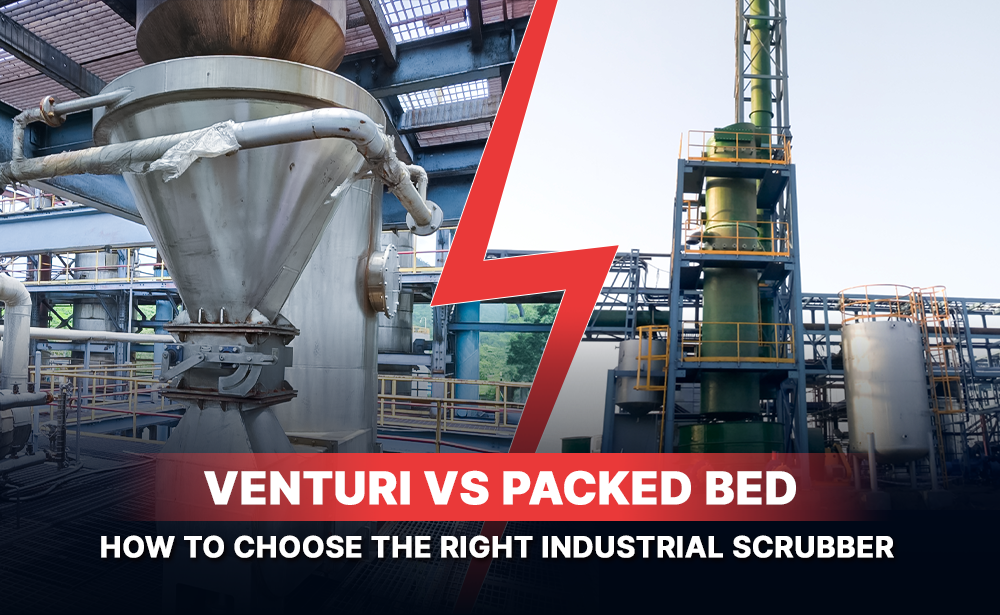
For engineers tasked with cleaning this contaminated gaseous stream, the first and most critical decision often narrows down to a classic choice: Venturi Scrubbers or Packed Bed Scrubbers? It’s a question that experienced wet scrubber manufacturers in India confront daily, guiding plant operations toward the most efficient solution.
The decision depends upon how to match a plant’s inherent strengths to a facility’s unique problem. Getting it right means achieving efficiency and reliability. Getting it wrong leads to a constant battle with underperformance.
The comparison becomes clearer when the fundamentals of each design are understood.
The Basic Blueprint: How Wet Scrubbers Clean the Contaminated Gaseous Stream
At its core, a wet scrubber operates on the principle that the Gas stream comes in contact with the liquid stream, and the pollutants get transferred to the Liquid stream.
This basic mechanism makes wet scrubbers widely applicable across industries handling dust, fumes, or chemically aggressive vapours.
This fundamental versatility is why these systems are such a common sight across industries. They aren’t just pollution control equipment; they also help to protect equipment from damage caused by corrosive substances.
Of course, not all scrubbers are the same. The real engineering genius lies in how that critical contact between gas and liquid is achieved. This is where the two dominant and distinctly different designs, the Venturi and the Packed Bed scrubber, comes to the picture.
The decision depends upon how to match a plant’s inherent strengths to a facility’s unique problem. Getting it right means achieving efficiency and reliability. Getting it wrong leads to a constant battle with underperformance.
The comparison becomes clearer when the fundamentals of each design are understood.
Venturi Scrubber: For Particle Collection in Gas Stream
The Venturi Scrubber operates on a principle of Interception, Impaction, and diffusion to extract particulate matter from the gas stream. The system accelerates the gas stream through an adjustable throat and compact design for high velocity.
This method makes the Venturi the ideal choice in environments where the air is thick with:
- Multiple Pollutants (Dust and Some Gases) need to be treated in a single device.
- Need to handle Abrasive, Corrosive, or Combustible dusts.
- High-temperature streams, sometimes exceeding 1000°C.
It’s no surprise to find Venturi Scrubbers standing guard in pharmaceutical powder suites, cement kilns, and metal smelting operations. They are the compact, heavy-duty solution when dust is the primary adversary.
Packed Bed Scrubber: Engineered for Gaseous Pollutant Absorption
The Packed Bed Scrubber achieves its purpose through maximized surface contact and mass transfer. This system is specifically engineered for the absorption and chemical neutralization of gaseous pollutants.
The Packed Bed Scrubber has a tower filled with packing media that can be arranged in a structured or random way. This gives it a huge surface area in a small space.
The working principle is based on counter-current flow. The contaminated gas stream comes up from the bottom, and a special scrubbing liquid is spread over the top of the packing and trickles down.
This design makes sure that the gas and liquid stay in close contact for a long time. As the two phases interact across the large surface of the packing, gaseous pollutants like HCl, SOx, or ammonia either dissolve into the liquid phase or react chemically, which cleans the gas stream.
This absorption-focused design makes the Packed Bed the technology of choice for a range of specific challenges, including:
- Taming corrosive acidic or alkaline fumes through neutralization.
- Capturing elusive solvent vapors and VOCs.
- Managing a complex mix of gaseous pollutants in a single unit.
Venturi vs. Packed Bed Scrubbers: A Side-by-Side Comparison
A simple rule of thumb helps clarify selection:
- Particulate-heavy gas stream → Venturi Scrubber
- Gas-dominant fume stream → Packed Bed Scrubber
Here’s a quick table to help understand the differences and make the right choice for a particular process:
| Parameter | Venturi Scrubber | Packed Bed Scrubber |
|---|---|---|
| Primary Function | Fine particulate removal | Gas absorption / neutralisation/Extraction |
| Use | Sub-micron dust (>99.9%) | Acidic, alkaline, VOC, toxic gases |
| Working Principle | High-velocity impact between droplets & particles | Gas-liquid contact via packing media |
| Pollutant Type | Dust, fumes, and certain gases | Acidic / alkaline gases, solvents |
| Footprint | Compact | Scalable / modular |
| Typical MOCs (Material of Construction) | MS, SS (Stainless Steel), FRP (Fibre Reinforced Plastic), Hastelloy | FRP (Fibre Reinforced Plastic), PP (Polypropylene), PVC (Polyvinyl Chloride), SS (Stainless Steel), PVDF (Polyvinylidene Fluoride) |
FGD Systems: For Special Purpose Scrubbing
Boilers, furnaces, and incinerators typically generate large volumes of hot flue gas with significant SOx concentrations. These require a dedicated Flue Gas Desulfurization (FGD) system rather than a standard scrubber.
FGDs are complete treatment units engineered for:
- High SOx load
- Elevated gas temperatures
- Reagent-based neutralisation (lime or caustic)
- Slurry preparation and gypsum recovery
Their design addresses conditions too demanding for general-purpose scrubbers.
Multi-Stage Scrubbers: When Gas Streams Contain Dust, VOCs, & Gaseous pollutants
Designing a scrubber system is never limited to choosing between Venturi and Packed Bed alone. Engineers evaluate the entire operating ecosystem, temperature extremes, gas composition, particulate load, corrosion potential, moisture behaviour, and long-term maintenance expectations.
Material selection becomes a strategic part of this evaluation. FRP may be appropriate for many streams, but highly aggressive chemical environments often require PVDF, PP, SS316L, Duplex, Hastelloy, or other specialised materials to ensure durability, resistance to corrosion, and long service life. These decisions directly influence both reliability and lifecycle performance.
However, many industrial exhaust streams are not purely “dust” or purely “fume.” They may be hot, particulate-laden, and chemically aggressive at the same time.
In such cases, material selection alone cannot resolve performance limitations.
For these situations, engineers rely on multi-stage scrubber systems, where each stage handles a specific pollutant type:
Quench or Venturi Scrubber
- reduces gas temperature
- extracts particulate
- stabilises the gas before absorption
Single or Multiple Packed Bed Stages
- neutralise acidic/alkaline gases
- extract solvent fumes or VOCs
Activated Carbon Bed (if required)
- final polishing for VOCs or trace organics
This combination ensures comprehensive treatment where a single technology would be insufficient.
Key Insights from Wet Scrubber Manufacturers in India
The most effective scrubber is the one matched to the pollutant profile, operating environment, and long-term behaviour of the gas stream.
For harsh, dusty environments filled with fine particulate, the Venturi scrubber is the go-to solution, built for durability and impact.
Whereas for processes plagued by acidic fumes, solvents, and chemical gases, the Packed Bed scrubber is the clear answer, as it is engineered for delicate absorption & Extraction.
Matching the technology to the pollutant is what separates an adequate system from a highly effective one.
If you'd like expert guidance on selecting the most suitable scrubber for your process, our engineering team can study your gas stream, layout, and operating conditions to recommend the most precise solution.
Frequently Asked Questions
Which scrubber is better for acidic fume scrubbing?
What about the versatility of FRP? Can it handle complex, mixed streams?
If a Venturi scrubber is for dust, can it also handle corrosive gases?
When does a Packed Bed Scrubber become the space-efficient choice?
This is a great engineering query. While tower-style vertical scrubbers are common, Packed Bed Scrubbers can be configured in a horizontal layout, which is a major space-saver in plants with limited vertical clearance or for retrofit projects.
Horizontal packed bed scrubbers offer the same efficient gas absorption without the need for a tall, structural tower, a solution often recommended by wet scrubber manufacturers in India for space-constrained facilities.
When is a multi-stage system recommended?
A multi-stage scrubber is essential when a single exhaust stream presents a dual challenge. The most common configuration uses a Venturi or Quench, followed by a Packed bed, and then an Activated Carbon bed/filter if VOCs are also present.
This sequential approach is one of the most effective ways to treat complex streams from sources such as incinerators thoroughly.