
How to Select the Right Industrial Scrubber for Your Industry (Chemical, Pharma, Metal)
Selecting an industrial air scrubber system for Indian plants is an engineering decision. A scrubber suitable for a chemical reactor’s acidic exhaust may not be appropriate for a pharmaceutical coating suite or a metal smelting furnace, and vice versa.
This guide simplifies the selection process by aligning scrubber choices with the specific emission profiles of three industries. Properly matching scrubber design to application ensures consistent compliance and reduces the need for repeated intervention.
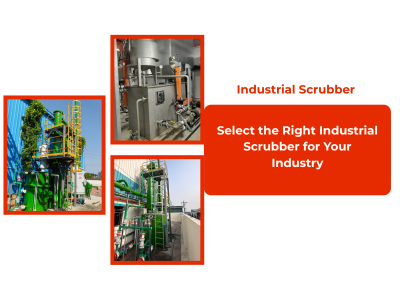
Start With the Exhaust Stream
Every scrubber selection starts with a key question: What pollutants are you dealing with?
The answer is rarely straightforward. Industrial exhaust streams often contain particulate matter, various gases, reactive fumes, VOCs, and moisture, with varying temperatures and flow rates depending on the process stage.
Selecting a scrubber with this data helps determine the right sizing, scrubbing media, and suitable construction material.
The critical process parameters that define your scrubber design:
- Gas composition — which pollutants are present and at what concentrations.
- Volumetric flow rate — determines system sizing and vessel dimensions.
- Inlet temperature — dictates whether a quench stage is required before treatment & for MOC selection.
- Pollutant type and loading — determine whether the system requires Venturi scrubbing, packed bed absorption, or a combined multi-stage configuration.
- Required outlet emission norm — CPCB and SPCB, or International guidelines for APC standards define the performance target that the system must consistently meet.
- Properties of pollutants — to select the area of classification
With this data, scrubber selection becomes a logical process rather than a guess.
Wet Scrubber for Chemical Industry Applications
Wet scrubbers for chemical industry applications address the widest range of pollutants. Batch reactors, distillation columns, solvent recovery units, and acid handling systems each produce distinct exhaust profiles, sometimes within the same facility.
Chemical fume scrubber design typically focuses on packed bed absorption, where a suitable scrubbing media such as caustic soda, lime solution, or a tailored chemical reagent, contacts the gas stream across a high-surface-area packing bed. This neutralises acidic/basic/corrosive gases such as HCl, HF, H₂S, HBr, and SOx in a single compact system.
If the process also generates particulate or sticky aerosols, a Venturi pre-stage captures particulates before the gas enters the packed bed. This protects the packing media from fouling and extends the system’s operational life between service intervals.
Material of construction is critical. Chemical exhaust streams often have pH ranges from near-zero to strongly alkaline. PP/ FRP, PVDF, SS304L, SS316L, SS904L and Hastelloy are standard options based on the chemical profile.
In specialty chemical, pesticide, paint, and pigment plants in India that use VOC scrubber systems, activated carbon polishing stages downstream of the packed bed provide the additional removal needed for complex organic vapors.
Scrubber for Pharma Emissions: Precision Over Capacity
Scrubber selection for pharma emissions presents a different engineering challenge. Pharmaceutical exhaust is not defined by extreme temperatures or high particulate loads, but by variability and sensitivity.
Tablet coating MKS (Microns Thickness Measurement) emit solvent-laden air with fluctuating VOC concentrations. API synthesis generates acidic fumes in batches rather than continuously. Solvent recovery operations produce mixed organic vapor streams that vary in composition depending on the product batch.
Air pollution control scrubbers for pharma typically combine packed bed absorption for soluble acid gases with an activated carbon stage for VOC and solvent vapor control. If API powder or fine dust is present, a low-velocity Venturi or HEPA (High-Efficiency Particulate Air) pre-filter prevents particulate carry-over into the absorption bed.
Two additional considerations define pharma scrubber design:
GMP-compatible construction. Internal surfaces and liquid distribution components must be compatible with pharmaceutical-grade process environments. SS316L is the standard metallic option.
Batch-mode operation. Unlike continuous chemical processes, pharma systems must perform reliably during start-stop cycles, variable emission loads, and campaign changeovers. Scrubber sizing and liquid recirculation design should account for peak load conditions rather than average throughput.
Flue Gas Scrubber Applications in Metal Processing
Flue gas scrubber applications in metal processing are among the most demanding. Arc furnaces, induction furnaces, smelters, and metal pickling lines generate exhaust conditions that rule out dry filtration due to high inlet temperatures, corrosive gas chemistry, and fine metallic particulate, creating a combined-pollutant challenge.
A flue gas scrubber for these applications typically employs a multi-stage configuration:
- A quench stage brings extreme inlet temperatures (up to 1100°C) down to the operating range of the scrubber vessel.
- A Venturi stage captures fine dust, fumes, and sub-micron particulate through high-velocity gas-liquid impaction.
- A packed bed absorbs residual acidic gases (SOx, HF, HCl) from the treated gas stream.
This integrated approach treats temperature, particulate, and gaseous pollutants in sequence within a single system footprint. The alternative, separate treatment stages from different suppliers, creates integration complexity and accountability gaps that multi-stage systems avoid.
Material selection for metal processing scrubbers must account for abrasive particulate and chemically aggressive condensate. SS316, Hastelloy, and refractory-lined options are matched to the specific metal process and inlet gas chemistry.
The Selection Matrix: Matching Scrubber to Industry
Industry | Primary Pollutants | Recommended Configuration | Key Design Consideration |
Chemical & Specialty Chemicals | HCl, HF, SOx, H₂S, VOCs, acidic fumes | Packed Bed ± Venturi pre-stage | MOC matched to gas chemistry; multi-bed for mixed acid/alkali streams |
Pharmaceutical | Solvent vapors, VOCs, API dust, acid gases | Packed Bed + Activated Carbon stage | Batch-mode sizing; GMP-compatible materials |
Metal Processing & Smelting | High-temp flue gas, SOx, HF, metallic fumes | Quench + Venturi + Packed Bed | Inlet temperature management; abrasion-resistant MOC |
Why Process Data Decides Everything
The table above provides direction, but no industrial scrubber selection guide can replace process data. Two chemical plants producing the same product can have significantly different exhaust profiles depending on reactor design, batch size, and raw material quality.
Scrubbers engineered from actual process data, such as gas composition, flow rate, inlet temperature, and outlet emission norms, consistently outperform systems selected from standard specifications. The most important design decisions include throat configuration in a Venturi, packing height and media type in a packed bed, liquid-to-gas ratio, recirculation pump sizing, and material selection for all wetted (contact) surfaces.
These are engineering decisions, not catalogue choices.
At TNBi Industries, every industrial air scrubber system commissioned by Indian plants is configured using process data, supported by patent-backed designs and proven performance across chemical, pharma, and metal processing applications.
Share your process requirements with us. We will design an optimized, cleaner solution tailored to your operational needs.
Frequently Asked Questions
What is the most important factor in industrial scrubber selection?
The exhaust stream composition is the most critical factor in selecting an industrial scrubber. Gas type, concentration, temperature, pressure, and flow rate together determine the scrubber configuration, construction material, and required scrubbing medium for consistent emission performance.
Which scrubber type is best for chemical plants?
Packed-bed scrubbers, often with a Venturi pre-stage for particulate-containing streams, are the standard wet scrubbers for chemical industry applications. For streams involving VOCs and organic vapors, an activated carbon polishing stage is added downstream.
How is a scrubber for pharma emissions different from those used in other industries?
Scrubber for pharma emissions must handle batch-mode operation, variable VOC loads, and GMP-compatible material requirements. The configuration typically combines packed-bed absorption with an activated-carbon stage, sized for peak batch concentrations rather than average throughput.
What are flue gas scrubber applications in metal processing?
Flue gas scrubber applications in metal processing include arc furnace off-gas treatment, smelting fume control, and metal pickling line emissions. Multi-stage systems combining quench, Venturi, and packed bed stages are standard for these high-temperature, mixed-pollutant streams.
Is a VOC scrubber system suitable for Indian regulatory compliance?
Yes. A properly designed VOC scrubber system used in India’s plants is engineered to meet CPCB and SPCB outlet emission norms. Packed-bed absorption with reactive scrubbing media, combined with activated carbon stages when needed, achieves the removal efficiencies required for regulatory compliance.