
Bag Filter vs Cartridge Filter: Which Dust Collection System is Better for Your Plant?
The bag filter vs cartridge filter question comes up in nearly every dust collector selection guide conversation, and the answer always depends on where it’s intended to be used. Both are fabric filtration systems. Both deliver high filtration efficiency. Both use pulse-jet cleaning. Yet they serve meaningfully different process conditions, and selecting one where the other belongs results in either oversized infrastructure or a system that underperforms its design potential.
This guide explains the engineering differences that inform selection, focusing on matching each system to specific process requirements rather than simply comparing features.
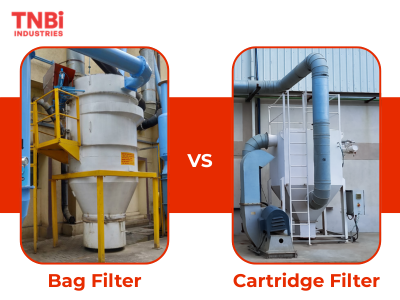
How Each System Filters: Same Principle, Different Geometry
Both pulse jet bag and cartridge filter systems use the same core mechanism: dust-laden air passes through a filter medium, particulate is captured on the surface, and a reverse pulse of compressed air periodically dislodges the dust cake into a collection hopper below.
The primary difference is the filter element geometry, which influences all other system characteristics.
A pulse jet bag filter uses cylindrical fabric bags, typically 100–200mm in diameter and 2–4 meters in length, supported by wire cages. The filter area per element is determined by bag length and diameter. For high gas volumes and heavy dust loads, additional bags are added. The system scales by increasing the number of filter elements within the vessel.
A cartridge filter uses pleated filter cartridges, a folded media configuration that provides significantly more filter surface area within a smaller volume. TNBi’s cartridge filters feature a multi-module design to handle high gas flow rates and deliver 99.9% filtration efficiency for fine dust, metalworking, welding, and powder applications.
This difference in design directly affects system footprint, dust load tolerance, and the range of applicable filter media.
Where the Bag Filter Leads: High Volume, Varied Conditions
The bag filter is fundamental to industrial dust collection in India’s most demanding applications. It is ideal where dust loads are high, gas volumes are large, or processes involve elevated temperatures and chemically diverse particulates.
Dust load capacity: Bag filters are engineered for high inlet dust concentrations. In industries such as cement, minerals, chemical powder handling, and bulk material transfer, they manage substantial and continuous dust loads due to their larger vessel size and filter surface area.
Temperature tolerance: Filter bag media options such as polyester, polypropylene, aramid, fiberglass, and PTFE enable TNBi’s bag filters to operate at temperatures up to 260°C, depending on the selected media. This makes them suitable for exhaust from dryers, furnaces, kilns, and calciners, where cartridge media may not perform reliably.
ATEX environments: For processes involving combustible dusts such as food powders, pharma APIs, chemical powders, and metal dust, TNBi’s ATEX-compliant bag filters offer appropriate design features. These include antistatic filter bags, earthing provisions, explosion vent options, explosion isolation valves,& other required instruments like Spark Arrestors, Bag Broken detectors, ATEX Certified Rotary Air Lock Valve etc. and support for Hazardous Area Classifications, i.e., Zone 0/20, 1/21, and 2/22.
Scalability for large airflows: Multi-compartment baghouse designs accommodate very large volumetric flow rates. For plant-wide dust extraction or centralized collection across multiple process points, bag filters scale more effectively than cartridge systems.
Typical industries: Chemicals, minerals, cement, food and pharma powders, metal powder, steel, material transfer and handling, grinding and milling.
Where the Cartridge Filter Leads: Compact Footprint, Fine Dust
The cartridge filter dust collector is designed for processes that generate fine to ultra-fine dust at moderate volumes, particularly in facilities where installation space is limited.
Filtration density: The pleated cartridge geometry provides more filter area per unit of floor space than a comparable bag filter. For a given airflow, cartridge filters require a smaller height, which is advantageous in fabrication units, CNC operations, compact process rooms, and retrofit installations where space is limited.
Fine and ultra-fine dust: Pleated cartridge media, especially PTFE-coated or nano-fibre variants, provide superior surface filtration for sub-micron particles. In metalworking, welding, paint and coatings, silo vent exhaust, and pharmaceutical powder handling at moderate volumes, this results in cleaner outlet air.
Customizable dust handling: TNBi’s cartridge filters offer flexible dust discharge options to meet process requirements, including rotary airlocks, screw conveyors, or sealed hoppers.
Lower gas volume applications: Cartridge filters are best suited for moderate airflow ranges. At significantly higher gas volumes, bag filters become more economical than cartridge configurations of equivalent capacity.
Typical industries: Fabrication, metalworking, CNC operations, paints, coatings and inks, pharma cleanrooms, silo venting, compact process rooms.
Side-by-Side: Industrial Dust Collection Systems Comparison
Parameter | Pulse Jet Bag Filter | Cartridge Filter |
Filter element | Cylindrical fabric bags | Pleated filter cartridges |
Filtration efficiency | Good for Larger particles | Excellent for fine particles |
Dust load handling | High inlet concentrations | Light to moderate dust loads |
Temperature range | Up to 260°C (media-dependent) | Up to 260°C (media-dependent) |
Footprint | Larger vessel; scales with airflow | Compact; high filter area per m² |
ATEX option | Yes — TNBi ATEX-compliant bag filter | Yes — TNBi ATEX-compliant Cartridge filter |
Typical gas volumes | High to very high | Moderate |
Best fit | Bulk powder, minerals, chemicals, food, pharma | Metalworking, fabrication, CNC, coatings, pharma cleanrooms Suitable for indoor installations |
Selection Logic: Based on Comparison of Dust Extraction Systems
Selecting a dust extraction system depends on four key process questions:
- What is the inlet dust concentration? Heavy, continuous dust loads favor the bag filter. Light to moderate concentrations are well-served by cartridge systems.
- What is the gas temperature? Elevated temperatures from drying, calcining, or furnace exhaust require bag filter media rated for those conditions. Cartridge filters are suited to ambient and moderate-temperature streams.
- What is the available installation space? Where footprint is constrained (retrofit projects, compact process rooms, cleanroom-adjacent installations), the cartridge filter’s density advantage is decisive.
- Does the dust present combustibility considerations? For processes involving combustible particulate, TNBi’s ATEX-compliant bag filter provides the appropriate engineering configuration.
In some plants, both systems serve different collection points simultaneously; bag filters on high-load production lines and cartridge filters at localized extraction points for space/food print issue, particle size.
Final Thoughts
Neither system is universally superior. The high-efficiency dust collector that delivers the best results is the one matched precisely to the process conditions, such as dust type, gas volume, temperature, space, and outlet emission requirements.
TNBi’s bag filters and cartridge filters are engineered based on process data rather than standard specifications. This ensures each system is configured for your plant’s specific dust profile and operating conditions, delivering cleaner emissions from the start.
Tell us about your process. We’ll design an optimized, cleaner solution tailored to your specific operational needs.
Frequently Asked Questions
What is the main difference between a bag filter and a cartridge filter?
The core bag filter vs cartridge filter difference lies in filter element geometry. Bag filters use cylindrical fabric bags suited to high dust loads and large gas volumes. Cartridge filters use pleated media elements that pack more filter area into a smaller footprint, making them ideal for fine dust at moderate airflow volumes and space-constrained installations.
Which is better for high-volume industrial dust collection?
For high-volume, high-load applications, such as cement, chemical powders, minerals, and bulk material handling, a pulse-jet bag filter is the appropriate choice. Its larger vessel and scalable bag count handle substantial inlet dust concentrations and high volumetric flow rates that cartridge systems are not designed for.
Can a cartridge filter match a bag filter’s efficiency?
Yes. TNBi’s cartridge filters deliver 99.9% filtration efficiency for fine and ultra-fine dust. Cartridge filter vs baghouse efficiency is comparable for the dust types and airflow volumes that cartridge systems are designed to handle.
Which dust collector is better for a compact plant layout?
The cartridge filter is the preferred high-efficiency dust collector where floor space is limited. Its pleated media geometry delivers high filter surface area per square meter of installation footprint, thus making it well-suited for fabrication units, CNC operations, retrofit installations, and compact process rooms.
Are TNBi’s bag filters suitable for combustible dust environments?
Yes. TNBi manufactures ATEX-compliant bag filters specifically designed for processes involving combustible particulate — food powders, pharma APIs, chemical powders, and metal dusts, with appropriate antistatic and safety engineering configurations as part of its industrial air filtration systems product range in India
What are the ATEX instruments provided?
TNBi provides a range of ATEX-compliant instruments:
- Explosion Isolation Valve
- Explosion Vents
- Bag Broken detectors
- Spark Arrestors
- All instruments, i.e., Solenoid Valves, DP Transmitters, Pulse jet controller etc.
- ATEX Certified Rotary Air Lock Valve