
Turnkey Air Pollution Control Projects (Greenfield): Benefits, Process & Cost Breakdown
When a manufacturing plant requires an air pollution control project (Greenfield) from the ground up, the initial decision is not about equipment selection but about project structure. Equipment selection, process engineering, fabrication, civil work, installation, and commissioning are all interdependent.
Turnkey air pollution control solutions mean assigning the entire scope, from process audit to stack emission testing, to a single engineering partner.
In the following sections, this guide explains the turnkey execution model and the factors influencing investment in industrial EPC pollution control projects.
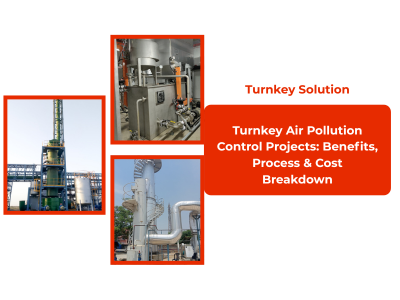
What Turnkey Means in APC Project Execution
The term “turnkey” is often used broadly in the industry. In air pollution control project execution, it specifically means the client defines the emission problem and compliance target, while the engineering partner assumes responsibility for all other aspects.
That scope includes:
- Process audit and emission characterization
- System design and equipment engineering
- Fabrication and quality inspection
- Supply of all ancillaries — ducting, fans, dampers, instrumentation, control panels
- Structural work at the site
- Installation and mechanical completion
- Commissioning, performance testing, training, and handover
The key difference is accountability.
In a supply-only arrangement, the plant team coordinates with various vendors and assumes integration risk.
While in a turnkey model, the APC engineering partner takes full responsibility for integration.
For plants whose internal engineering teams are focused on core operations or where the APC system requires multiple coordinated treatment stages, the turnkey model delivers more effective outcomes with fewer coordination challenges.
The Execution Process: Stage by Stage
Turnkey pollution control systems follow a defined project sequence. Each stage builds on the previous one, so compressing the process can compromise system performance.
Stage 1 — Process Audit and Emission Characterization
Every customized APC project in India starts with an analysis of the exhaust stream. TNBi’s engineers assess the pollutant profile, including gas composition, particulate loading, volumetric flow rate, inlet temperature, and moisture content, along with applicable CPCB or SPCB emission norms. This data informs all subsequent design decisions.
Stage 2 — System Design and Engineering
Based on the process audit, the appropriate treatment configuration is selected. For example, a chemical plant processing acidic gases may need a Multi-Stage Packed-Bed Scrubber with Venturi pre-treatment, while a cement grinding unit may require a Pulse-Jet Bag Filter with high-temperature media. A metal processing facility may need a quench-Venturi-packed bed sequence. The design is tailored to the emission profile rather than being generic to the industry.
At this stage, construction materials, fan and pump sizing, pressure drop calculations, and structural load data are finalized. P&ID and GA drawings are provided for client review before fabrication begins.
Stage 3 — Fabrication and Quality Inspection
Equipment is fabricated at TNBi’s Pune facility. For industrial emission control projects, material traceability, weld quality, and thickness verification are standard inspection steps. Ancillary components such as ducting, expansion joints, rotary airlocks, and control panels are fabricated or sourced to project specifications and inspected before dispatch.
Stage 4 — Civil and Structural Work
Foundation design, equipment support structures, access platforms, and cable trays are engineered to match the system layout and site conditions. When civil work is performed by a contractor unfamiliar with the APC system, issues such as mismatched anchor bolt patterns, inadequate foundation loads, or restricted access can arise. Turnkey execution prevents these problems.
Stage 5 — Installation and Commissioning
Erection is supervised by TNBi’s field engineers. Commissioning includes the sequential start-up of each system component, verification of gas-flow distribution, instrumentation calibration, and adjustment of operating parameters to meet design conditions. The system is handed over only after stack emission performance meets the specified outlet norms.
What Drives the APC Project Cost for the Complete Project
APC project cost in India depends on more than just equipment. For plants evaluating industrial EPC pollution control investments, understanding the cost variables enables more accurate budget planning than relying on general estimates.
Pollutant profile and treatment stages: A single-stage packed-bed scrubber for a soluble acid gas differs significantly from a multi-stage system treating combined particulate, acid gas, and VOC streams. Each additional treatment stage, such as Venturi, packed bed, activated carbon, or bag filter, increases engineering, fabrication, and operational complexity.
Gas volume and system sizing: Volumetric flow rate determines equipment dimensions, fan motor capacity, ductwork diameter, and vessel size. For example, systems handling 10,000 Nm³/hr and 100,000 Nm³/hr are structurally different, with distinct foundation requirements, fan selections, and instrumentation scopes.
Material of Construction (MOC): For corrosive gas streams such as HCl, HF, SOx, or HBr, mild steel is not suitable. Materials such as FRP, PVDF, SS316L, and Hastelloy are selected based on their chemical profiles. The cost difference between MS and Hastelloy is significant and dictated by the gas stream’s requirements.
Site conditions and civil scope: Greenfield installations on prepared sites with easy access differ greatly from retrofits in operating plants, where space is limited, existing structures must be accommodated, and installations must be sequenced to avoid production interruptions. Civil scope is project-specific and requires an on-site assessment.
Distance and logistics: For customized Greenfield APC projects in India, sites located far from the fabrication facility incur additional costs for transport, site mobilization, and accommodation for field engineers. These costs vary by location and site accessibility.
Instrumentation and control integration: Options range from basic on-off control panels to PLC-based automation with HMI and full DCS integration with the plant’s control system. The appropriate level is determined by the plant’s operational model and the number of system parameters requiring continuous monitoring.
The most reliable way to obtain an accurate project cost estimate is through a process data sheet and a site visit, rather than relying solely on equipment type quotations.
Why Single-Source Turnkey Execution Matters
The alternative to turnkey pollution control systems involves coordinating multiple vendors across design, supply, civil, and installation, which disperses accountability. If a system underperforms relative to its design emission target, determining responsibility becomes a coordination issue rather than an engineering one.
Single-source industrial EPC pollution control execution ensures that one engineering team manages the process audit data, system design, fabrication quality, installation, and commissioning. Design intent is maintained throughout every stage. When commissioning adjustments are required, the same team that specified the system implements them.
For industrial emission control projects that must meet CPCB and SPCB stack emission norms from the outset, this continuity is not just convenient; it is an engineering requirement.
TNBi’s Turnkey APC Capability
TNBi Industries has delivered turnkey air pollution control solutions for the chemicals, pharmaceuticals, metals, steel, paint, tyre, explosives, fertilizer, cement, food processing, power, and specialty manufacturing sectors, utilizing patent-backed designs for Scrubbers and Classifiers. We also design and build bag filters, cyclone separators, and multi-stage combined systems.
Each project begins with a process audit. Every system is engineered based on this data, and every installation is commissioned to verify stack emission performance.
Share your process requirements, and our team will design an optimized, cleaner solution tailored to your operational needs.
Frequently Asked Questions
What is a turnkey air pollution control project?
A turnkey air pollution control project (Greenfield) places complete responsibility, from process audit and system design through fabrication, installation, and commissioning, with a single engineering partner. The client defines the emission profile and compliance target; the turnkey partner delivers a commissioned, performance-verified system.
What does the APC project cost in India depend on?
The pollutant profile and number of treatment stages, gas volume and system sizing, material of construction requirements, civil and structural scope, site conditions, and the level of instrumentation and control integration required govern APC project costs in India. Each variable is project-specific and determined by process data, not equipment category.
What is the difference between turnkey and supply-only APC contracts?
In a supply-only contract, the plant coordinates equipment suppliers, civil contractors, and installation teams independently and owns the integration risk. In turnkey pollution control systems, the engineering partner owns the full scope, including design, fabrication, civil works, installation, and commissioning, and is accountable for the system’s emissions performance at handover.
How long does an industrial APC project take from audit to commissioning?
Air pollution control project execution timelines vary by system complexity, site conditions, and civil scope. Simple single-stage systems for smaller gas volumes can be commissioned in a matter of months. Multi-stage systems for high-volume, complex emission streams with significant civil work require longer project schedules. TNBi establishes project timelines based on the specific scope after the process audit and site assessment.
Can TNBi handle APC projects for plants outside Maharashtra?
Yes. TNBi executes customized APC solutions in India and Worldwide, with fabrication at its Pune facility and field engineering teams deployed to project sites. Site conditions, logistics, and access are assessed during the pre-engineering stage and factored into the project plan.