
Air Classifier Manufacturers in India: How to Select the Right Technology
In modern manufacturing, achieving the right particle size results in consistent product quality, improved process efficiency, higher material recovery and low maintenance. Whether your plant works with chemicals, minerals, pigments, food powders, polymer compounding companies (masterbatch producers), or specialty materials, the right industrial air classifier can make a big difference.
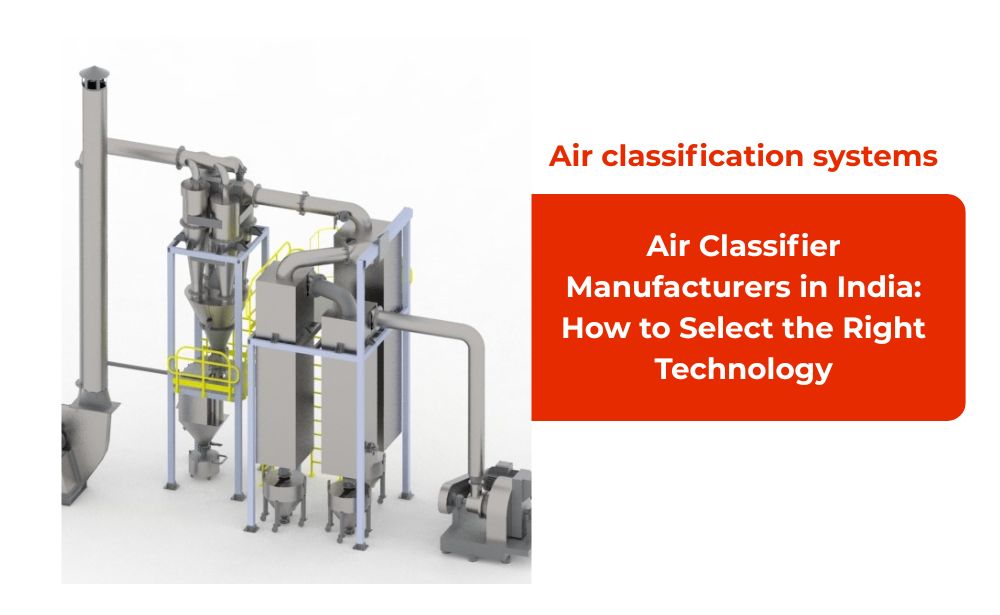
The key is to find a fine-particle separation technology that matches your material properties, throughput requirements, and target particle size. This goes beyond simply choosing among air classifier manufacturers in India.
This guide gives plant managers, operations heads, and process teams a clear look at how air classification systems work dynamically, which technologies suit different applications, and how to choose the best long-term solution for your operation.
Why Fine Particle Separation Technology Matters in Modern Manufacturing
In powder processing and classification systems, particle size directly influences how the product performs throughout the manufacturing cycle.
The right fine particle separation technology improves flow, blending, yield, and product finish. It also increases throughput, reduces downtime, and helps your plant deliver high-quality results every time.
An efficient classification system supports:
- uniform particle size distribution
- improved product consistency
- better recovery of valuable material
- smoother downstream processing
- reduced product variation
For industries that work with powders and fine solids, these benefits lead to more efficient, stable manufacturing operations.
How Industrial Air Classifier Machines Support Better Powder Processing
An Industrial Air Classifier Machine is a type of Powder Classification Equipment that separates particles based on their size, density, and aerodynamic properties.
Unlike conventional sieving methods, Air Classification Systems use controlled airflow to separate finer particles from coarser fractions.
This technology is especially useful for dry powder applications where consistency and precision matter most.
How Air Classification Systems Work
The working principle is based on aerodynamic separation.
Material enters the classification chamber and is exposed to a controlled air stream. Based on size, density, and drag force, particles separate into fine and coarse fractions.
Finer particles travel with the airflow, while larger particles are collected separately for recirculation or discharge.
When to Use Powder Classification Equipment Instead of Mechanical Screening
For fine powders and applications requiring a narrow particle size distribution, Powder Classification Equipment often performs better than mechanical screens.
Air-based systems are especially useful where:
- Consistent production is required
- Finer product separation required (<10 Micron)
- An add-on blending operation required .
- Consistent production is required.
- Finer product separation is required (<10 Micron).
- An add-on to the blending operation is required.
- High-volume throughput is needed.
This is why many advanced manufacturing plants choose Air Classification Systems to improve their processes.
Which Air Classification Technology Is Right for Your Process
Every manufacturing environment is unique and requires a customized approach to fine particle separation technology.
Static Air Classification Systems for Low-Maintenance Operations
Static systems use controlled airflow with minimal mechanical movement.
TNBi’s patented Industrial Air Classifier Machine is designed with no moving parts, which helps support:
- Low wear and tear
- Stable throughput
- Consistent separation
- Low maintenance requirements
- Highly enhance safety
This solution is ideal for plants that want long-term operational excellence and efficiency.
Air Classifier Mill Manufacturers for Integrated Grinding and Separation
Solutions from Air Classifier Mill Manufacturers combine grinding and classification in a single integrated system.
These are ideal for processes that require:
- Simultaneous size reduction
- Fine particle classification
- Compact integrated processing
This technology offers high efficiency and product quality for metal powder, food powder, pigments, pharmaceuticals, and specialty chemical applications.
Multi-Stage Air Classification Systems for Finer Control
For plants requiring finer particle distribution, multi-stage Air Classification Systems offer better control over multiple cut sizes. This helps advanced powder processing operations achieve top-quality products.
Select Based on Target Particle Size Range
The first factor to evaluate is the required particle size range.
- Determine both the minimum and maximum particle sizes.
- Consider whether you require finer control of particles.
TNBi’s Fine Particle Separation Technology separates particles from 5 to 300 microns, making it suitable for both fine- and medium-particle processing.
Evaluate Material Characteristics and Powder Behavior
Different materials respond differently to airflow-based separation.
Before selecting Powder Classification Equipment, evaluate:
- Density
- Abrasiveness
- Moisture level
- Stickiness
- Agglomeration tendency
- Particle size distribution
By evaluating these material characteristics, you can choose a technology that consistently delivers reliable separation while maintaining your desired productivity and product quality.
Compare Throughput and Plant Capacity Requirements
Production scale is another important factor.
TNBi’s Air Classification Systems are designed for product loads from 100 kg/hr up to 300 tons/hr, making them suitable for both mid-scale and large industrial plants.
Consider Maintenance and Operating Efficiency
For plant teams, low-maintenance systems help improve long-term efficiency.
TNBi’s Industrial Classification System features an innovative design with no moving parts, minimizing wear and supporting long-term high performance.
What to Look for in Air Classifier Manufacturers in India
When evaluating air classifier manufacturers in India, it is important to look beyond the equipment itself.
The right technology partner should offer:
Process Engineering and Application Expertise
The ability to understand your material and application requirements.
Technology Capability Across Particle Ranges
Support for the micron range required by your process.
Low-Maintenance Air Classification Systems
Systems designed for stable industrial performance.
Scalability for Industrial Production Volumes
Equipment suitable for your plant’s current and future production needs.
For plant managers and procurement teams, these factors provide lasting value that goes beyond the initial equipment investment.
Why TNBi’s Fine Particle Separation Technology Stands Out
TNBi’s fine particle separation technology offers new solutions for industrial applications where precision and operational excellence are important.
Key features include:
- patented design
- no moving parts
- low maintenance
- separation range of 5–300 microns
- product load up to 300 T/hr
- secondary air fine-tuning
This is why TNBi’s industrial air classifier machine is a strong option for process-driven manufacturing environments focused on progress.
Final Thoughts
Selecting the right Industrial Classification System is about choosing technology that aligns with your material properties, production scale, and target particle size.
By choosing the right Air Classification Systems, plants can consistently improve product quality, boost material recovery, reduce operational bottlenecks, and enhance overall manufacturing efficiency.
For plant operators, TNBi’s Fine Particle Separation Technology offers stability, precision, and easy maintenance. Contact TNBi today to discuss your process needs and learn how our solutions can improve your plant’s performance.
Frequently Asked Questions
What is an industrial air classifier machine?
An industrial air classifier machine separates particles based on size, shape, and density using controlled airflow. It is widely used in dry powder processing where consistent particle size and material recovery are important for product quality and process efficiency.
Which industries use air classification systems?
Air classification systems are widely used in chemicals, minerals, cement, food powders, pharmaceuticals, and specialty materials. They are ideal wherever fine particle separation technology is required to improve consistency, yield, and downstream process performance.
What is the difference between an air classifier and an air classifier mill?
An air classifier separates particles based on size, while an air classifier mill combines grinding and classification in a single system. The choice depends on whether the process requires only powder classification equipment or integrated size reduction.