
Top Industrial Dust Collector Manufacturers in India: How to Choose the Right Partner
India’s manufacturing sector includes Cement, Steel, Chemicals, Pharmaceuticals, Food Processing, Mining, Paint, Tyre, Solar, Fertilizers, and the expanding EV supply chain, each producing unique dust and particulate profiles. Industrial dust collection systems are essential for safeguarding the environment, protecting equipment, and ensuring stack emissions meet CPCB standards and International Air Quality Guidelines.
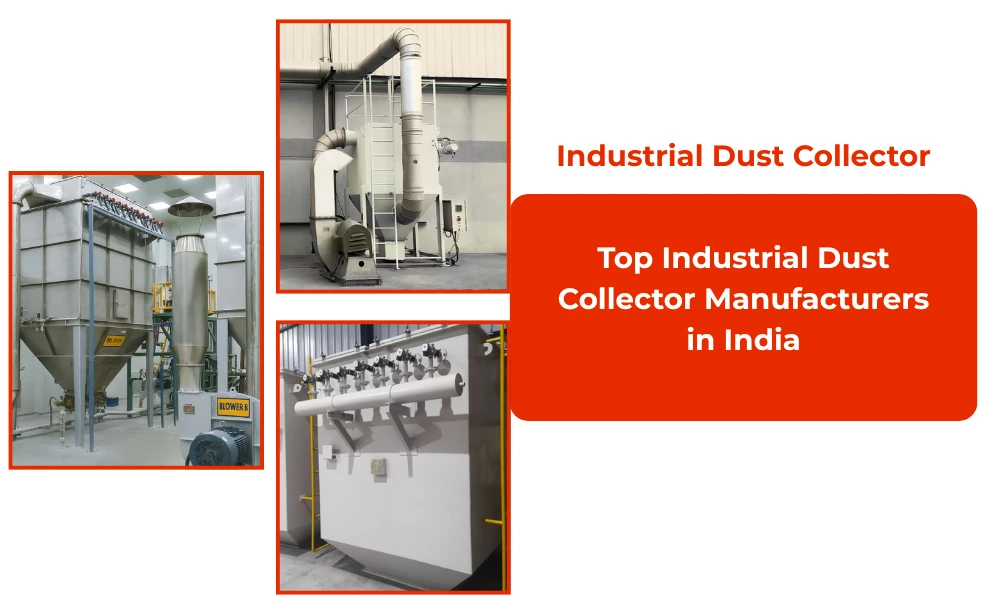
The market for dust collector manufacturers in India is well developed. Engineering firms in Pune, Ahmedabad, Mumbai, Chennai, and Delhi NCR offer the full range, from pulse-jet Bag Filter manufacturers and Cyclone Separator specialists to integrated Industrial Air Filtration System providers offering wet scrubbing and multi-stage configurations.
Choosing the right partner comes down to matching the manufacturer’s engineering capabilities to the plant’s specific dust profile, operating conditions, and compliance requirements. This guide covers the available Industrial Dust Collection Systems in India, the CPCB norms that apply, and the practical criteria for evaluating a Dust Extraction System manufacturer as a long-term partner.
Industrial Dust Collection System Types Available in India
India’s Dust Extraction System manufacturers produce the full range of dust collection technologies. The right type depends on the dust profile, temperature, and whether the process produces both particulate and gaseous pollutants simultaneously.
Pulse Jet Bag Filter (Baghouse)
Pulse-jet Bag Filters are the most widely used Industrial Dust Collection Systems in Indian manufacturing. They capture fine particulates on fabric filter bags and clean them with short bursts of compressed air, enabling continuous operation. Filtration efficiency exceeds 99.9% for sub-micron particles.
Filter bags are available in polyester, polypropylene, aramid, fiberglass, or PTFE, selected according to operating temperature (up to 260°C) and chemical exposure. ATEX-compliant options are offered for combustible dust environments.
Cyclone Separator
Cyclone separators are centrifugal Dust Extraction Systems that do not use filter media or moving parts. Dust-laden gas enters tangentially, and centrifugal force drives particles to the wall, where they fall into the collection hopper. Clean gas exits from the top.
High-efficiency Cyclone Separators can handle inlet temperatures up to 1100°C and are often used as a pre-stage before bag filters. They are especially suitable for Cement, Ash-handling, Boiler application, Power Plants, and Heavy Mineral-Processing applications where dust loads exceed the capacity of Bag Filters alone.
Wet Scrubber
Where the process involves both particulate and gaseous pollutants together, or where the dust is combustible, sticky, or chemically aggressive, an Industrial Air Filtration System based on wet scrubbing provides the appropriate treatment. Venturi scrubbers capture fine particulate through high-velocity gas-liquid contact. Packed-bed Scrubbers absorb soluble gases by mass transfer. Multi-Stage configurations combine both.
Wet Scrubbers can handle inlet temperatures up to 1100°C and treat a wide range of gases, including HCl, HF, SOx, NOx, NH₃, H₂S, HBr, HCN, VAM, VOCs, and others, often within a compact system.
Cartridge Dust Collector
Cartridge Dust Collectors are compact Industrial Dust Collection Systems that use pleated Cartridge Filters, providing a larger filter surface area in a smaller footprint. They are ideal for Cleanrooms, Pharmaceutical Facilities, Metalworking Shops, and Food Processing Operations where dust loads are moderate and space is limited.
Types of Dust Collection Systems (And Their Applications)
System type | Best suited for | Key design advantage | Common industries |
Pulse Jet Bag Filter | Fine particulate, dust, powder | 99.9%+ efficiency, auto-cleaning | Chemicals, Pharma, Food, Mining, Paint, Tyre, Welding Fumes etc. |
Cyclone Separator | Heavy/coarse dust, high temperatures | No moving parts, 1100°C rated | Cement, Iron Powder, And Ash Handling |
Wet Scrubber | Particulate + gaseous pollutants | Multi-pollutant treatment in one unit | Chemicals, Metals, Pharma, EV, Solar, Explosives, Fertilizers |
Cartridge Dust Collector | Light-to-moderate dust loads | Compact, high filter surface area | Food, Pharma Cleanrooms, Metalworking |
What India's Emission Standards Require
The CPCB and State Pollution Control Boards set permissible particulate matter concentrations for stacks and boundary zones in each industry category. Effective dust collection systems are engineered to meet these standards consistently throughout their operational life, not just at commissioning.
System design standards also play an important role in long-term performance and reliability. Reputable manufacturers design equipment according to established industrial engineering standards based on application requirements.
For example, Industrial Bag Filters are commonly designed following ACGIH guidelines for ventilation and dust collection, FRP Scrubber Systems are manufactured as per BS4994 / EN13121 standards, and metallic process equipment is designed in accordance with ASME standards for structural and process integrity.
Key reference points for stack particulate emissions in India:
- General industrial processes: 150 mg/Nm³ for older installations; 50–100 mg/Nm³ for newer and notified categories
- Cement and power: 50 mg/Nm³ stack limit, with PM10 controls for ambient air quality
- Pharma and fine chemicals: GMP-grade handling requirements, with stricter ambient limits in notified industrial zones
- Fugitive emissions: Controlled at transfer points, material handling, and grinding operations through enclosed industrial dust collection systems with defined capture velocities
How to Evaluate a Dust Collector Manufacturer in India
India’s dust collector manufacturers market includes engineering firms with in-house design, fabrication, and commissioning, as well as suppliers of standard products. Selecting the right partner requires evaluating six key areas.
1. Engineering from Process Data
A properly specified dust collection system begins with process data, including dust type and composition, inlet dust loading, gas flow rate, inlet temperature, and target outlet emissions. This data informs system sizing, filter media selection, and material of construction.
Manufacturers with strong engineering capabilities request this data upfront to configure the system accurately. While standard specifications provide a baseline, the final design must reflect the plant’s actual operating conditions.
2. Technology Range and Application Matching
Different dusts require different solutions. Fine pharmaceutical API dust, abrasive cement dust, and high-moisture food-processing powder each have different filtration requirements. A dust extraction system manufacturer whose range covers bag filters, cyclone separators, wet scrubbers, and integrated multi-stage systems is better positioned to recommend the appropriate technology for each application.
The ability to match technology to the pollutant profile, such as recommending a wet scrubber or cyclone when appropriate, demonstrates strong application experience.
3. Industry Track Record
Cement dust, pharmaceutical powder, and iron ore fine particles each pose unique design challenges. Experience in one sector does not guarantee expertise in another. Reviewing commissioned installations with measurable emission data in your industry is the most reliable performance indicator.
4. Material of Construction
The Material of Construction (MOC) selection directly impacts system longevity and performance. Mild steel or carbon steel is suitable for dry particulate applications in ambient conditions.
For chemical environments, pharmaceutical processes, or corrosive gas streams, options include SS304, SS316, SS904L, FRP, PVDF, PTFE, and specialty alloys such as Hastelloy C-22, etc.
The recommended MOC should align with the process’s gas chemistry and temperature profile, supported by the manufacturer’s engineering rationale.
5. In-House Manufacturing
Comprehensive dust collector manufacturers in India design, fabricate, and commission systems in-house. This includes LASER cutting, precise filter cage welding, production of rotary air lock valves, and quality control at every stage. In-house manufacturing ensures dimensional accuracy and consistent quality.
Knowing which components are fabricated in-house versus sourced externally clarifies accountability for quality. This distinction affects lead times, spare parts availability, and post-commissioning support.
6. After-Sales Support
Dust extraction systems require ongoing maintenance, including filter bag replacement, pulse-jet timing calibration, rotary airlock servicing, and the provision of spare parts. Plants across India benefit from responsive after-sales support, such as Annual Maintenance Contracts, stocked spare parts, and defined service response times, which are important for the total cost of ownership.
Partner Selection Checklist
A structured evaluation of these seven areas offers a consistent framework for comparing dust collector manufacturers in India.
What to Evaluate | What to Look For |
Design & Engineering Capability | Ability to design systems based on actual process data, dust profile, airflow, temperature, and required outlet emissions |
Manufacturing Standards | In-house fabrication, quality control processes, precision welding, and adherence to recognized engineering standards |
Technology Range | Capability to offer Bag Filters, Cyclone Separators, Wet Scrubbers, Cartridge Filters, and integrated multi-stage systems |
Industry Experience | Proven installations across industries such as chemicals, pharma, cement, food processing, mining, and metal processing etc. |
Installation & Execution Capability | Ability to handle complete installation, commissioning, and integration with existing plant systems |
Material of Construction Expertise | Correct selection of SS304, SS316, FRP, PTFE, Hastelloy, and other materials based on process conditions |
Performance Commitment | Defined outlet emission performance, filtration efficiency, and operational reliability commitments |
After-Sales & Customer Support | Spare parts availability, AMC support, response time, troubleshooting, and long-term service support |
TNBi Industries: Industrial Dust Collection Systems from Pune
Since 2012, TNBi Industries has designed and manufactured industrial dust collection systems in Pune. The product range includes bag filters (Pulse-Jet, with ATEX-Compliant options, Vent Filters), Cyclone Separators, Wet Scrubbers (Venturi, Packed-Bed, and Multi-Stage), Classifiers for powder separation, and Pneumatic Conveying Systems for dust-free material transfer.
Each system is configured using process data, including inlet dust load, gas composition, temperature, and outlet emission standards.
Engineering highlights:
- Pulse Jet Bag Filters: Over 99.9% filtration efficiency, ATEX-compliant options, multiple filter media choices (polyester, aramid, PTFE, fiberglass), and an automatic cleaning system.
- Cyclone Separators: Patented involute design, rated for up to 1100°C, operate without moving parts, and can be used as standalone units
- Wet Scrubbers: Venturi, packed-bed, and multi-stage configurations for the simultaneous treatment of particulate and gaseous pollutants, with material options ranging from FRP to Hastelloy.
- Classifiers: Patented design with no moving parts for fine powder separation (5–300 µm), integrated with bag filters for closed-loop operation.
- Industries served: Chemicals, Pharmaceuticals, Food, Iron Powder, Metal Processing, Fertilizers, Power, EV Batteries, Solar, Explosive, Cement, Mining, and many more.
Conclusion
India’s dust collector manufacturers’ market offers a broad range of engineering capabilities. The most effective partners begin with process data, select technology suited to the specific dust profile, and engineer systems to achieve measurable emission performance.
Regardless of whether the application requires a pulse-jet bag filter, cyclone separator, wet scrubber, or a multi-stage industrial air filtration system, the selection criteria remain the same: process-based engineering, appropriate technology, suitable material of construction, CPCB-compliant performance, and reliable post-commissioning support.
Share your dust collection requirements with us. We will design an optimized, compliant solution tailored to your process and operating conditions.
sales@tnbiindustries.com | +91 92255 61222 | Contact Us
Frequently Asked Questions
What is the most commonly used industrial dust collection system in manufacturing plants?
The most common industrial dust collection system is the pulse-jet bag filter because it offers over 99.9% filtration efficiency for fine dust and continuous operation. It is widely used in chemicals, pharmaceuticals, food processing, mining, and powder handling across Indian manufacturing plants.
How do I choose the right dust collector manufacturer in India?
Choose a dust collector manufacturer in India based on process engineering capability, technology range, industry experience, material options, and after-sales support. The best manufacturers evaluate dust type, airflow, temperature, and emission requirements before recommending a system.
What is the difference between a cyclone separator and a bag filter?
A cyclone separator removes heavy and coarse particles using centrifugal force and works well as a pre-stage system. A bag filter captures fine particulate matter with filter media. Many industrial plants use both together for better dust collection efficiency.
Which industries require wet scrubbers instead of dry dust collectors?
Wet scrubbers are preferred when particulate and gaseous pollutants are present, especially in chemical, pharmaceutical, metal, and fertilizer plants. They are ideal for handling acidic fumes, VOCs, sticky dust, and corrosive gases that dry dust collectors cannot treat effectively.
Why is CPCB compliance important when selecting industrial air filtration systems?
CPCB compliance ensures your industrial air filtration systems meet permissible particulate emission limits for stack and boundary air quality. A properly engineered dust collection system maintains long-term performance, supports smoother operations, and ensures the plant consistently meets environmental standards.