
Multi-Stage Scrubber System: Design, Working & Selection
Industries use a Multi-Stage Scrubber System when a single treatment technology cannot efficiently remove all contaminants present in an industrial exhaust stream. Modern manufacturing processes often generate mixed emissions containing particulate matter, acid gases, solvent vapors, odors, and other pollutants that require different treatment mechanisms.
While a single scrubber may perform well for a specific contaminant, it is rarely optimized for handling multiple pollutant types at the same time. For this reason, industries such as chemicals, pharmaceuticals, fertilizers, metal processing, and specialty manufacturing increasingly rely on multi-stage configurations. These configurations combine particulate removal, gas absorption, and VOC treatment into a single integrated system.
This guide explains the working principle of the Multi-Stage Scrubber, when a two-stage scrubber design is sufficient, how a combined gas-and-particle scrubber is configured, and the key factors engineers evaluate when designing scrubber systems for mixed industrial emissions.
Why Single-Stage Scrubbers Struggle With Mixed Emissions
Every air pollution control technology is designed around a specific removal mechanism.
A Venturi Scrubber is highly effective at removing particulates. A Packed Bed Scrubber is optimized for gas absorption. Activated Carbon systems excel at VOC and odor control.
The challenge arises when an exhaust stream contains multiple pollutant types.
Consider the following examples:
Emission Stream | Challenge |
Dust + HCl fumes | Particulate removal and gas absorption require different treatment methods |
SO₂ + VOCs | Gas absorption alone may not effectively capture residual VOCs |
H₂S + Particulate Matter | Dust can reduce the effectiveness of downstream gas treatment stages |
Pharmaceutical Exhaust | Solvent vapors, acid fumes, and API particulate may require multiple treatment technologies |
In these situations, a single-stage scrubber may address one pollutant effectively while leaving others untreated. A multi-stage approach lets each treatment stage focus on the contaminants it handles best.
What Is a Multi-Stage Scrubber System?
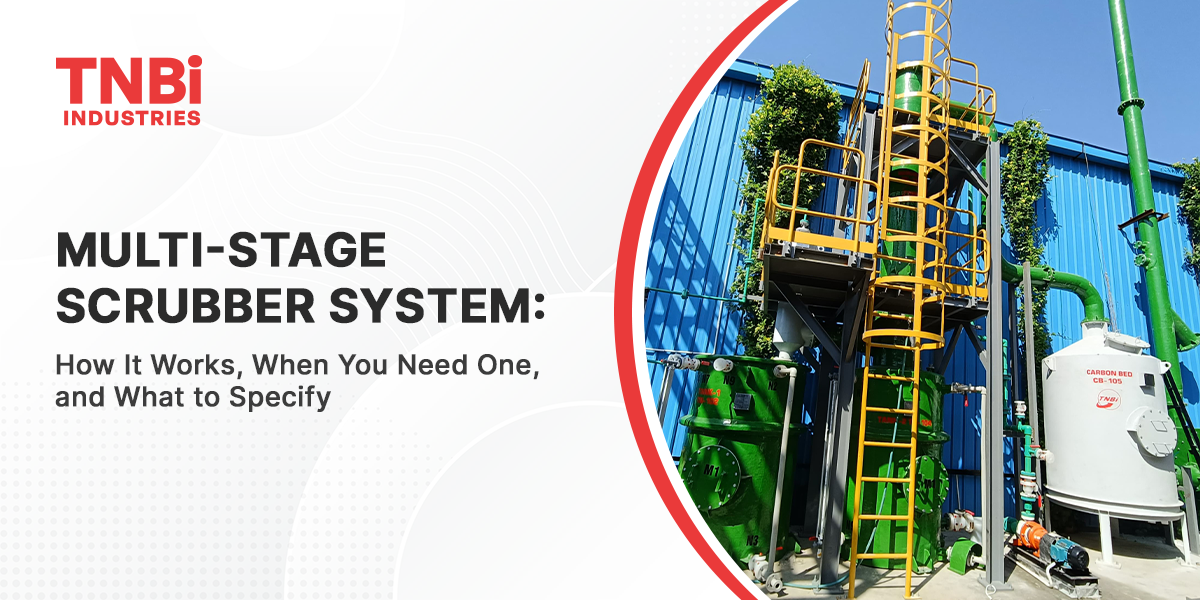
A Multi-Stage Scrubber System combines two or more treatment technologies arranged in sequence to remove different pollutants from a single exhaust stream.
Instead of relying on one treatment mechanism, the system uses multiple stages to progressively clean the gas stream.
Common configurations include:
- Quench + Venturi Scrubber + Packed Bed Scrubber
- Venturi Scrubber + Two Stage Packed Bed Scrubber
- Packed Bed Scrubber + Activated Carbon Filter
- Venturi Scrubber + Packed Bed Scrubber + Activated Carbon Filter
Each stage performs a specific function before the gas enters the next treatment step.
This staged approach improves overall treatment efficiency. It also allows each technology to operate under conditions where it performs most effectively.
Understanding the Multi-Stage Scrubber Working Principle
The Multi-Stage Scrubber Working Principle is based on sequential removal of pollutants.
Different contaminants are removed at different stages based on their physical and chemical characteristics.
Stage 1: Particulate Removal
The first stage typically removes dust, aerosols, and suspended particulate matter.
Engineers commonly use a Venturi Scrubber because it can efficiently capture fine particulate matter through high-energy gas-liquid contact.
Removing particulates first helps protect downstream equipment from fouling and performance degradation.
Stage 2: Gas Absorption
After particulate removal, the gas stream enters a Packed Bed Scrubber.
This stage is designed to absorb and neutralize pollutants such as:
- HCl
- HF
- SO₂
- H₂S
- NH₃
- Chlorine
Engineers select the scrubbing liquid chemistry based on the specific gases present in the exhaust stream.
Stage 3: VOC and Odor Polishing
Where solvent vapors, VOCs, or odor-causing compounds remain, engineers often install an Activated Carbon Filter as the final stage.
This polishing stage removes trace contaminants that are difficult to capture through wet scrubbing alone.
The result is a highly efficient treatment sequence. It is capable of handling complex industrial emissions.
How Engineers Decide Whether a Multi-Stage Scrubber Is Necessary
Not every application requires multiple treatment stages.
The decision depends on the emission profile.
Emission Characteristics | Recommended Solution |
Particulate only | Venturi Scrubber |
Acid gases only | Packed Bed Scrubber |
VOCs only | Activated Carbon Filter |
Particulate + Acid Gases | Two Stage Scrubber Design |
Acid Gases + VOCs | Packed Bed + Activated Carbon |
Particulate + Acid Gases + VOCs | Multi Stage Scrubber System |
The more diverse the contaminant profile, the greater the likelihood that multiple treatment stages will be required.
Common Multi-Stage Configurations Used in Industry
Different industries require different combinations of treatment technologies.
Quench + Venturi Scrubber + Packed Bed Scrubber
This configuration adds a quench stage ahead of particulate and gas treatment, specifically to handle exhaust streams that arrive too hot for direct scrubbing.
It is typically used where exhaust streams contain:
- Very high inlet gas temperatures
- Particulate matter
- Acid gases or corrosive fumes
The quench stage rapidly cools the incoming gas, usually through direct water spray contact, before it reaches the Venturi section. This protects downstream equipment from thermal stress and prevents damage to scrubber internals and packing media. The Venturi stage then removes particulate matter, and the Packed Bed stage handles gas absorption.
This sequence is common in metal processing facilities, incinerators, and other high-temperature industrial processes where gas cannot be sent directly into a Venturi or Packed Bed system without pre-cooling.
Quench + Packed Bed Scrubber
Where the exhaust stream carries acid gases and high heat but minimal particulate loading, a Quench + Packed Bed configuration is often sufficient, without a dedicated Venturi stage.
Common applications include:
- High-temperature gas absorption processes
- Chemical reactor vents with low dust loading
- Streams requiring rapid gas cooling before absorption
In this arrangement, the quench stage cools the gas and provides an initial layer of gas absorption and coarse particulate knockdown, while the Packed Bed stage completes the fine gas absorption and neutralization. This configuration reduces system footprint and cost compared to a full three-stage train when particulate control isn’t the primary concern.
Designing a Combined Gas and Particulate Scrubber
A combined gas-and-particle scrubber must be designed around the removal sequence rather than the equipment itself.
The order of treatment stages is critical.
In most applications:
- Particulate removal occurs first.
- Gas absorption occurs second.
- VOC polishing occurs last.
This arrangement improves overall system efficiency. It prevents particulate matter from reaching and interfering with downstream treatment stages.
A poorly sequenced system may experience:
- Increased maintenance
- Packing fouling
- Higher pressure drop
- Reduced absorption efficiency
Proper stage sequencing is therefore one of the most important design considerations in multi-stage systems.
The Key Parameters Engineers Evaluate
Successful Multi-Stage Scrubber performance depends on understanding the emission profile before selecting equipment.
Pollutant Composition
The first step is identifying the contaminants present in the exhaust stream and their concentrations.
Particulate Loading
Dust concentration influences the selection of particulate removal equipment and affects downstream treatment requirements.
Gas Flow Rate
Flow rate impacts scrubber sizing, pressure drop, and residence time.
Temperature
Plant operators may need to cool or quench high-temperature gas streams before the gas enters downstream treatment stages.
Moisture Content
Moisture influences both gas absorption efficiency and VOC treatment performance.
Required Outlet Emission Levels
Performance targets determine the number of stages and treatment technologies required.
Corrosion Profile
The chemical characteristics of the gas stream influence material selection.
Material of Construction (MOC)
Depending on the application, manufacturers may use the following materials to construct systems:
- FRP
- PP
- PVC
- PVDF
- SS304
- SS316L
- Specialty alloys
Plant operators often consider material compatibility to be as important as the treatment technology itself.
Common Multi-Stage Scrubber Design Mistakes
Many operational problems originate during system design rather than during operation.
Incorrect Stage Sequence
Prioritizing gas absorption over particulate removal can reduce system efficiency and increase maintenance requirements.
Underestimating Particulate Loading
High dust loads can overwhelm downstream treatment stages if not addressed early in the process.
Ignoring VOC Polishing Requirements
Gas absorption alone may not adequately remove residual VOCs or odors.
Incompatible Material Selection
Material selection that does not match the chemical characteristics of the exhaust stream often leads to corrosion-related failures.
Designing Each Stage Independently
Each stage must be evaluated as part of an integrated system rather than as standalone equipment.
What to Specify Before Requesting a Scrubber Design
If you provide accurate process information, engineers can recommend the most suitable treatment approach.
The following information should typically be available:
- List of pollutants present
- Pollutant concentrations
- Gas flow rate
- Temperature & Pressure
- Moisture content
- Particulate loading
- Operating hours
- Required outlet emission levels
- Existing treatment equipment
The quality of this data directly influences system performance and design accuracy.
What to Specify Before Requesting a Scrubber Design
A successful scrubber for mixed emissions is designed around the pollutant profile rather than around standard equipment configurations.
Understanding the contaminants, treatment objectives, and operating conditions allows engineers to select the most appropriate combination of technologies. This approach also optimizes performance, reliability, and operating efficiency.
Final Thoughts
A Multi-Stage Scrubber System provides a practical solution when industrial exhaust streams contain multiple pollutant types requiring different treatment mechanisms.
By combining particulate removal, gas absorption, and VOC polishing within a single treatment sequence, these systems can achieve significantly higher overall treatment performance than a single-stage approach.
Success depends on understanding the emission profile. It also requires selecting the correct treatment sequence and designing each stage as part of an integrated air pollution control strategy.
Frequently Asked Questions
What is a Multi-Stage Scrubber System?
A Multi-Stage Scrubber System combines two or more pollutant-removal technologies in sequence to treat mixed industrial emissions. Typical configurations include Quench + Venturi Scrubbers, Packed Bed Scrubbers, and Activated Carbon Filters, each designed to target specific contaminants such as particulates, gases, VOCs, and odors.
How does a Multi-Stage Scrubber work?
The Multi-Stage Scrubber working principle involves sequential treatment. Particulate matter is typically removed first, followed by gas absorption and then VOC polishing. Each stage addresses a specific contaminant type, allowing the system to achieve higher treatment efficiency for complex industrial exhaust streams.
When should I choose a Multi-Stage Scrubber instead of a single-stage system?
A Multi-Stage Scrubber is recommended when the exhaust stream contains multiple pollutant types such as particulate matter, acid gases, solvent vapors, or odors. Single-stage systems are typically optimized for one removal mechanism, whereas multi-stage systems can address mixed emissions more effectively.
What is the difference between a two-stage scrubber and a multi-stage scrubber?
A two-stage scrubber uses two treatment technologies. For example, it might combine a Venturi Scrubber with a Packed Bed Scrubber, or a Quench with a Packed Bed Scrubber. A multi-stage scrubber system has three or more treatment steps. These can include setups like Quench, Venturi, and Packed Bed together, or systems that add activated carbon filtration to control VOCs and remove odours in the final stage.
Can a Multi-Stage Scrubber remove both particulate matter and VOCs?
Yes. A properly designed Multi-Stage Scrubber System can remove particulate matter, acid gases, VOCs, and odors by combining different treatment technologies. The specific configuration depends on the emission profile, treatment objectives, and required outlet performance levels.