
Packed Bed Scrubber Design: Key Parameters & Sizing Guide
Industrial exhaust streams often contain more than a single pollutant. Depending on the process, they may include acidic gases, alkaline fumes like solvent vapors, odorous compounds, or a combination of contaminants, like HF, HCL, Nitric Acid, Formic acid, Methane, Sulphonic Acid, Tartoric Acid, that require effective treatment before discharge and nickel leaching.
For these applications, a packed bed scrubber design is widely used because it provides efficient gas absorption and chemical neutralization within a compact system.
However, the performance of a packed bed scrubber depends on much more than selecting a tower and filling it with packing media.
Factors such as gas composition, pollutant concentration, scrubbing liquid chemistry, liquid distribution, packing selection, residence time, and operating conditions all influence absorption efficiency and long-term system performance.
This guide explains the packed bed scrubber working principle, key design parameters, packed tower scrubber packing media options, common design challenges, and the factors engineers evaluate during packed bed scrubber sizing to achieve reliable and efficient pollutant removal.
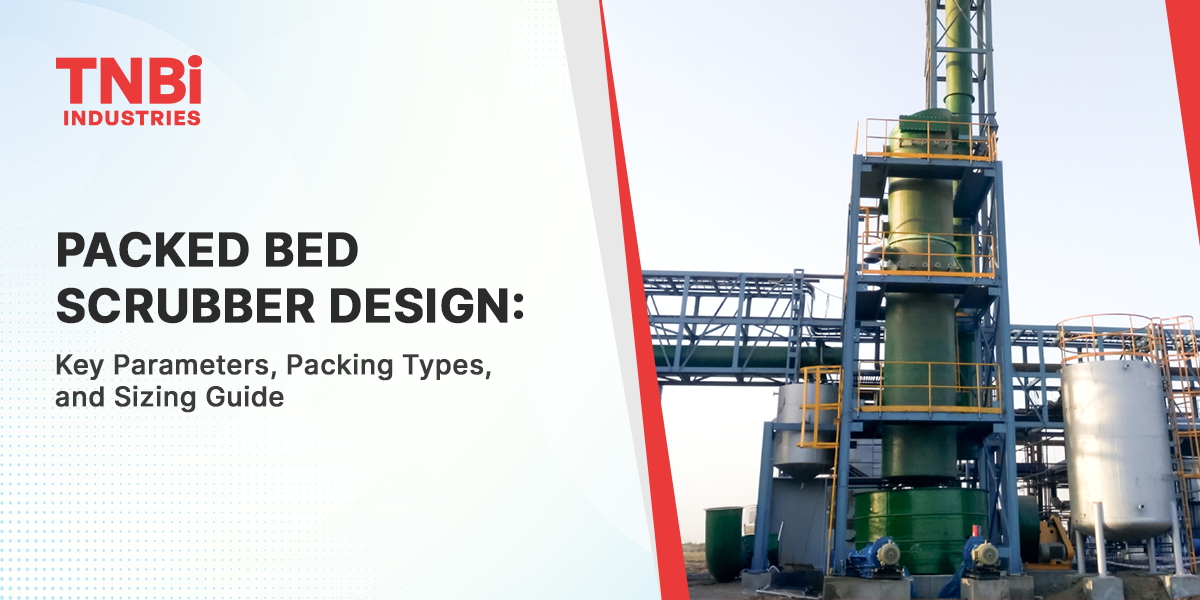
Understanding the Packed Bed Scrubber Working Principle
A packed bed scrubber is designed to remove gaseous pollutants by maximizing contact between the contaminated gas stream and a scrubbing liquid. It is widely used for treating acid gases, alkaline fumes, VOCs, solvent vapors, and mixed chemical emissions.
The packed bed scrubber working principle is based on two mechanisms: absorption and chemical reaction. Soluble pollutants such as ammonia (NH₃) and hydrogen fluoride (HF) are absorbed into the scrubbing liquid, while gases such as SO₂ and H₂S are typically neutralized through chemical reaction with the scrubbing solution.
The scrubber tower contains structured or random packed tower scrubber packing media that creates a large wetted surface area for gas-liquid interaction. Contaminated gas enters from the bottom of the tower and flows upward through the packed section, while scrubbing liquid is distributed from the top and flows downward across the packing.
As the gas passes through the wetted packing bed, pollutants either dissolve into the liquid phase or react with the scrubbing solution. The cleaned gas then passes through a mist eliminator or demister section before exiting the scrubber, while the liquid containing the absorbed contaminants is collected for recirculation, treatment, or controlled discharge.
Why Counter-Current Flow Improve Efficiency
Most packed bed scrubbers use a counter-current arrangement where gas and liquid flow in opposite directions.
In this configuration, the gas and liquid streams flow in opposite directions, maintaining a high mass transfer driving force throughout the packed section. This enhances absorption efficiency, improves pollutant removal performance, and allows more effective utilization of the scrubbing liquid.
The Key Parameters That Define Packed Bed Scrubber Design
A successful packed-bed scrubber design begins with understanding the exhaust stream, pollutant characteristics, treatment objectives, and process conditions the system must handle.
Gas Composition and Pollutant Concentration
The first step in any acid gas scrubber design is to identify the contaminants present in the exhaust stream and their concentrations.
Common contaminants include:
- Hydrochloric Acid (HCl)
- Sulfur Dioxide (SO₂)
- Ammonia (NH₃)
- Hydrogen Fluoride (HF)
- Chlorine
- VOCs and solvent vapors
Different pollutants require different treatment approaches. The contaminant profile influences the selection of scrubbing liquid, packing media, material of construction, and the overall absorption strategy.
Scrubbing Liquid Chemistry
The effectiveness of a packed bed scrubber depends not only on the pollutant being removed but also on the chemistry of the scrubbing solution.
For example:
- Caustic solutions are commonly used for acidic gases such as HCl and SO₂.
- Acidic solutions may be used for ammonia removal.
- Oxidizing solutions can improve the treatment of specific sulfur compounds and odorous gases.
Selecting the appropriate scrubbing media is often one of the most critical design decisions in achieving the required removal efficiency.
Gas Flow Rate and Residence Time
Gas flow rate directly affects scrubber
sizing and overall system configuration.
Higher gas volumes typically require larger tower diameters to maintain suitable gas velocities through the packed section. Adequate residence time is necessary to ensure sufficient contact between the gas stream and scrubbing liquid for effective pollutant absorption.
Inlet Temperature and Moisture Content
Temperature influences both absorption efficiency and material selection.
High-temperature gas streams may require quenching before entering the scrubber. Moisture levels also affect pressure drop, packing performance, and liquid distribution.
Required Outlet Emission Levels
The required outlet concentration establishes the system’s performance target.
More stringent emission limits may require increased packing depth, optimized liquid-to-gas ratios, higher recirculation rates, or multi-stage treatment systems to consistently achieve the desired removal efficiency.
Material of Construction
Material is a critical packed-bed scrubber design consideration. The gas chemistry, operating temperature, and corrosion potential often determine the right MoC for the construction of the scrubber.
For corrosive environments, material compatibility is often as important as the absorption design itself.
Depending on the application, packed bed scrubbers may be constructed using:
- FRP
- PP
- PVC
- PVDF
- HDPE
- SS304
- SS316L
- Specialty alloys
Choosing the Right Packed Tower Scrubber Packing Media
The packing section is often considered the heart of a packed-bed scrubber.
The purpose of packed tower scrubber packing media is to provide a large surface area for gas-liquid interaction. More surface area generally translates into better absorption efficiency.
The choice of packing depends on:
- Gas flow rate
- Pressure drop
- Corrosiveness of the gas/liquid
- Operating temperature
- Removal efficiency
- Cost considerations
There are two main categories of packing: Random Packing and Structured Packing.
Random Packing Media
Random packing is commonly used across industrial scrubber applications due to its versatility, high efficiency, and cost-effectiveness.
Typical examples include:
- Q-Pac
- Pall Rings
- Raschig Rings
- Berl Saddles
- Cascade Mini Rings
These packing types provide good mass transfer performance while maintaining a relatively low pressure drop.
Structured Packing Media
Structured packing consists of engineered layers arranged in a defined geometric pattern.
Typical examples include:
- Corrugated Sheet Packing
- Wire Mesh Packing
- Honeycomb Packing
These packing types provide uniform liquid distribution, lower energy consumption, and a more compact tower design.
Random and structured packings are manufactured in a variety of materials, including metallic grades (SS304, SS316), ceramics, and non-metallic polymers such as PP, PVDF, and PVC, to suit different process and corrosion-resistance requirements.
Packing Material | Advantages |
Metallic (SS304, SS316) | High mechanical strength, good heat resistance |
Ceramic | Excellent corrosion and temperature resistance |
Non-metallic (PP, PVC, PVDF) | Economical, lightweight, highly resistant to corrosion and chemicals |
Packed Bed Scrubber Sizing: What Engineers Consider
Correctly sized packed bed scrubbers ensure the system delivers the required performance without excessive energy consumption or operating costs.
Tower Diameter
Tower diameter is primarily determined by gas flow rate and allowable gas velocity.
A properly sized tower prevents flooding, maintains efficient gas-liquid contact, and minimizes unnecessary pressure drop.
Packing Height
Packing height determines the available contact area within the scrubber.
Higher pollutant concentrations or stricter emission targets often require deeper packed sections to achieve the desired absorption efficiency.
Liquid-to-Gas Ratio
The liquid-to-gas ratio is one of the most important design parameters.
Insufficient liquid flow reduces absorption efficiency, while excessive liquid circulation increases pumping requirements and operating costs.
Pressure Drop Considerations
Pressure drop directly influences fan power consumption.
The objective is to achieve the required removal efficiency while maintaining an acceptable operating cost throughout the system’s lifecycle.
Common Packed Bed Scrubber Design Challenges
Even a well-sized scrubber can experience performance issues if critical design considerations are overlooked.
Packing Fouling and Scaling
Sticky particulates, salts, and condensable compounds can accumulate on packing surfaces over time. This reduces available surface area and can increase pressure drop across the scrubber.
Uneven Liquid Distribution
Effective pollutant absorption depends on uniform liquid distribution throughout the packed section.
Poor distributor design can create dry zones where gas bypasses the scrubbing liquid, reducing overall efficiency.
Excessive Pressure Drop
Higher pressure drop increases fan energy requirements and operating costs.
Proper packing selection and gas velocity control help balance efficiency and power consumption.
Corrosion and Material Compatibility
Acid gases and reactive compounds can rapidly degrade unsuitable materials.
Material selection should always be based on process chemistry, operating temperature, and long-term service conditions.
Incorrect Packing Media Selection
Selecting the wrong packing media can limit mass transfer performance and reduce scrubber effectiveness.
Proper wet scrubber packing selection should consider pollutant type, corrosion resistance, pressure drop, and operating temperature.
How Engineers Optimize Packed Bed Scrubber Performance
Once the basic design is established, engineers focus on improving absorption efficiency while maintaining practical operating costs.
Common optimization strategies include:
- Selecting packing media with high surface area and appropriate void volume
- Maintaining uniform liquid distribution throughout the packed section
- Optimizing liquid-to-gas ratios based on pollutant loading
- Monitoring pressure drop to identify fouling or scaling issues
- Using corrosion-resistant materials for long-term reliability
In many applications, these factors have a greater impact on performance than simply increasing tower size.
The Importance of Process-Led Design
The most effective scrubber systems are designed around the characteristics of the exhaust stream rather than standard equipment sizes.
Gas composition, pollutant concentration, temperature, pressure, flow rate, and emission targets all influence the final configuration. Understanding these factors during the design stage helps ensure the selected system delivers the required performance while remaining practical to operate and maintain over the long term.
Final Thoughts
A successful packed-bed scrubber design is more than just tower size.
The most effective systems are built around the characteristics of the exhaust stream, the pollutant type, the packing media selection, the liquid distribution, and the performance objectives.
Whether the application involves acid gases, solvent vapors, odors, or chemical process emissions, understanding the packed bed scrubber working principle, selecting the right packing media, and performing proper packed bed scrubber sizing are essential for achieving reliable long-term performance.
For industrial applications, a process-led design approach consistently delivers better efficiency, lower operating costs, and more dependable results than selecting equipment based solely on generic specifications.
Frequently Asked Questions
How does a packed bed scrubber work?
A packed-bed scrubber removes gaseous pollutants by bringing contaminated air into contact with a scrubbing liquid in a packed media bed. The large contact area created by the packing improves mass transfer, allowing pollutants to be absorbed efficiently before clean air exits the system.
What is the best packing media for a packed-bed scrubber?
The best packed tower scrubber packing media depend on gas composition, temperature, pressure drop requirements, and corrosion conditions. Plastic packing is commonly used for corrosive gases, ceramic packing is suited to high-temperature applications, and metallic packing is preferred where mechanical strength is important.
How is packed-bed scrubber sizing determined?
Packed bed scrubber sizing is based on gas flow rate, pollutant concentration, required removal efficiency, liquid-to-gas ratio, and pressure drop limitations. These factors determine tower diameter, packing height, and liquid circulation requirements needed for effective pollutant absorption.
What is the difference between a packed bed scrubber and a Venturi scrubber?
A packed bed scrubber is primarily used for gas absorption and VOC treatment, while a Venturi scrubber is designed for particulate removal. In applications that contain both dust and gaseous pollutants, the two technologies are often combined into a multi-stage treatment system.
Which industries use packed bed scrubbers?
Packed bed scrubbers are widely used in chemical processing, pharmaceuticals, fertilizers, metal finishing, petrochemicals, and specialty manufacturing industries where acid gases, solvent vapors, odors, or corrosive emissions require efficient treatment.