
Pneumatic Conveying System Design: Key Factors for Efficient Bulk Material Handling
Reliable pneumatic conveying system design is achieved by carefully matching system parameters to material behavior.
For example, two plants handling powder at the same throughput may require different conveying systems, pipeline layouts, and operating pressures based on the material’s properties in motion.
This guide outlines the design decisions that determine whether a bulk material handling system in India delivers consistent, efficient transfer or requires frequent intervention to maintain performance.
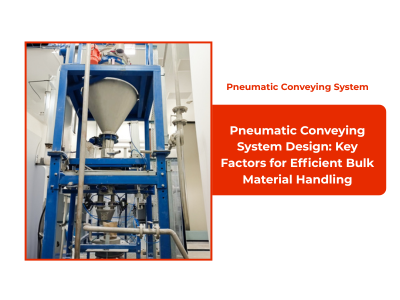
How Pneumatic Conveying Systems Work
A pneumatic conveying system transfers dry bulk materials, such as powders, granules, and abrasives, through sealed pipelines using air or any other gas as the conveying medium. The system operates using either positive pressure, which pushes material from source to destination, or vacuum, which pulls it.
The sealed pipeline is the defining feature of this technology. Unlike mechanical conveyors such as screw, belt, or bucket elevators, pneumatic systems have no open transfer points, spillage, or cross-contamination between material and environment.
For hygroscopic powders, food-grade materials, fine chemicals, and pharmaceutical APIs, this is as important as conveying capacity.
Inert gas conveying further enhances this principle. For combustible, reactive, or moisture-sensitive materials, a closed-loop inert gas system replaces air as the conveying medium, maintaining product integrity throughout the transfer process.
The Central Design Decision: Lean Phase vs Dense Phase
Every industrial conveying system design starts with a key decision: lean-phase or dense-phase conveying. This choice determines the operating pressure, gas velocity, pipeline sizing, and the range of materials the system can reliably handle.
Lean-phase conveying suspends the material in a high-velocity airstream, carrying it continuously through the pipeline. Two configurations are available:
- Vacuum-type lean phase: Handles up to 20 TPH, conveying distances up to 150 meters, and operates at vacuum levels up to (–) 0.7 BarG. Suitable for chips, fine powders, and low-density materials. This configuration is especially effective when multiple pickup points feed into a single destination.
- Pressure-type lean phase: Handles up to 50 TPH, conveying distances up to 300 meters, and operates at pressures up to 1 Bar. Suitable for bulk powders, jumbo bag unloading, bulker unloading, and mildly abrasive materials.
Dense phase conveying operates at lower gas velocity and higher pressure. Material moves through the pipeline in slugs or as a moving bed, rather than as a suspended stream. Capacity can reach up to 300 TPH, with conveying distances up to 450 meters and operating pressures up to 8 Bar.
This system is suitable for fly ash, abrasive powders, and materials where high-velocity conveying would cause product degradation or excessive pipeline wear.
The selection depends on material characteristics, required capacity, conveying distance, and acceptable product degradation. Both lean and dense phase systems are available in vacuum and pressure configurations.
Key Design Parameters for Pneumatic Conveying System Design
Once the right conveying solution is selected, a set of interrelated parameters is examined to decide the system design. Adjusting one parameter affects the others, so you must base pneumatic conveyor calculations on accurate material data.
Material characteristics: Bulk density, particle size distribution, abrasiveness, moisture content, cohesiveness, and combustibility directly influence the conveying system, pipeline material, gas velocity, and choice of conveying medium.
For instance, a material that flows freely at ambient conditions may become cohesive under heat or pressure, so the system must be designed for actual process conditions rather than laboratory averages.
Conveying distance and layout: Pipeline routing, including total length, number of bends, vertical lifts, and changes in direction, determines the pressure drop across the system. Each bend adds resistance equivalent to several meters of straight pipe.
Take, for example, a system designed for 200 meters of straight horizontal run. This requires a different pressure calculation than one with multiple vertical lifts and tight-radius bends over the same distance.
Capacity and throughput: Required TPH determines pipeline diameter, compressor or vacuum pump sizing, and the number of conveying lines. For processes with variable throughput or batch operation, the system should be sized for peak demand rather than average flow.
Operating pressure: Lean phase systems operate at up to 1 Bar (pressure) or (–) 0.7 BarG (vacuum), while dense phase systems operate at up to 8 Bar. Pipeline material, fitting specifications, rotary airlock design, and filter receiver sizing must be rated for the system’s operating pressure.
Multiple source and destination points: TNBi’s systems support multiple suction and discharge points within a single conveying circuit, enabling plant layouts where material is drawn from several silos or delivered to multiple process points.
Dense Phase Conveying for Challenging Ash Handling Applications
Fly ash handling is among the most technically demanding applications in bulk material handling systems in India and is a common use case for dense phase pneumatic conveying.
Fly ash is fine and abrasive, and its moisture content and particle size distribution vary depending on combustion conditions. At the flow rates required for power plants and cement operations, high-velocity lean phase conveying would cause excessive pipeline wear and particle degradation.
Dense phase conveying directly addresses these challenges. At TNBi, we customize the design of dense-phase systems for ash-handling applications (as per the client’s requirements and pollutant profile).
Low gas velocity, high operating pressure, and slug-flow material movement minimize abrasive contact with pipeline walls. With capacities up to 300 TPH and conveying distances up to 450 meters, TNBi’s dense-phase systems are engineered to meet the throughput and distance requirements of industrial-scale ash handling.
Lean Phase vs Dense Phase Conveying: Selecting by Application
Vacuum Conveying (Lean Phase) | Pressure Conveying (Lean Phase) | Dense Phase Conveying | |
Capacity | Up to 20 TPH | Up to 50 TPH | Up to 300 TPH |
Conveying Distance | Up to 150 m | Up to 300 m | Up to 450 m |
Operating Pressure/Vacuum | Up to (–) 0.7 BarG | Up to 1 Bar | Up to 8 Bar |
Gas Velocity | High | High | Low |
Ideal Materials | Chips, fine powders, low-density materials | Bulk powders, bulker/jumbo bag unloading, mildly abrasive | Fly ash, abrasive powders, and fragile materials |
Key Advantage | Multiple pickup points; enclosed transfer | Long-distance bulk transfer | Minimal product degradation; pipeline longevity |
Industries Served by TNBi Powder Conveying Systems
TNBi’s pneumatic conveying systems are engineered for a wide range of sectors where enclosed, reliable bulk transfer is essential:
Pharmaceuticals, food and beverage, steel and metallurgy, cement and building materials, chemicals and petrochemicals, power and energy, agro and processing industries, paints, pigments and dyes, pulp, paper and textiles, and soaps and detergents.
Material profiles across these sectors vary significantly, from fragile API granules that must reach the next process stage without degradation to abrasive fly ash volumes that would quickly wear out a mechanical conveyor. Powder conveying system applications in India require designs tailored to specific material behavior rather than generalized by industry category.
Final Thoughts
Efficient pneumatic conveying system design depends on understanding material behavior before selecting a conveying system. Whether in the lean or dense phase, under vacuum or pressure, with air or an inert gas, each decision should be based on the material’s requirements, travel distance, and flow rate.
TNBi’s pneumatic conveying systems are custom-engineered to your material type, flow rate, conveying distance, layout, and safety requirements, including closed-loop inert gas configurations for combustible or reactive materials.
Share your process requirements with us. We will design an optimized, cleaner solution tailored to your specific operational needs.
Frequently Asked Questions
What is a pneumatic conveying system, and how does it work?
A pneumatic conveying system transfers dry bulk materials such as powders, granules, and abrasives through sealed pipelines using air or inert gas as the conveying medium. The system operates using either positive pressure, which pushes material from source to destination, or vacuum, which pulls it, enabling fully enclosed, dust-free transfer across the required distance.
What is the difference between the lean phase and dense phase conveying?
Lean-phase vs. dense-phase conveying differ in gas velocity, operating pressure, and material movement patterns. The lean phase uses high-velocity, low-pressure air to suspend and continuously carry material through the pipeline. Dense phase uses low-velocity, high-pressure air to move material in slugs, making it suitable for abrasive, fragile, or high-throughput materials where product integrity and pipeline longevity are priorities.
What capacity and distance can TNBi pneumatic conveying systems achieve?
TNBi’s dense-phase pneumatic conveying systems handle capacities up to 300 TPH over distances up to 450 meters at operating pressures up to 8 Bar. Pressure-type lean phase systems handle up to 50 TPH across 300 meters, while vacuum-type lean phase systems handle up to 20 TPH across 150 meters.
What materials can be conveyed through TNBi's systems?
TNBi’s industrial conveying system design accommodates powders, granules, and abrasives across a wide range of industries, including fly ash, bulk chemicals, pharmaceutical APIs, food powders, cement, pigments, and more. For combustible or moisture-sensitive materials, closed-loop inert gas conveying is available as part of the system configuration.
Can TNBi pneumatic conveying systems handle multiple source and discharge points?
Yes. TNBi’s systems support multiple suction and discharge points within a single conveying circuit, enabling flexible plant layouts for bulk material handling system applications in India without duplicating conveying infrastructure for each source-to-destination pair.