
Safety First – Implementing ATEX Bag Filter Systems for Hazardous Dust Collection in Pharma
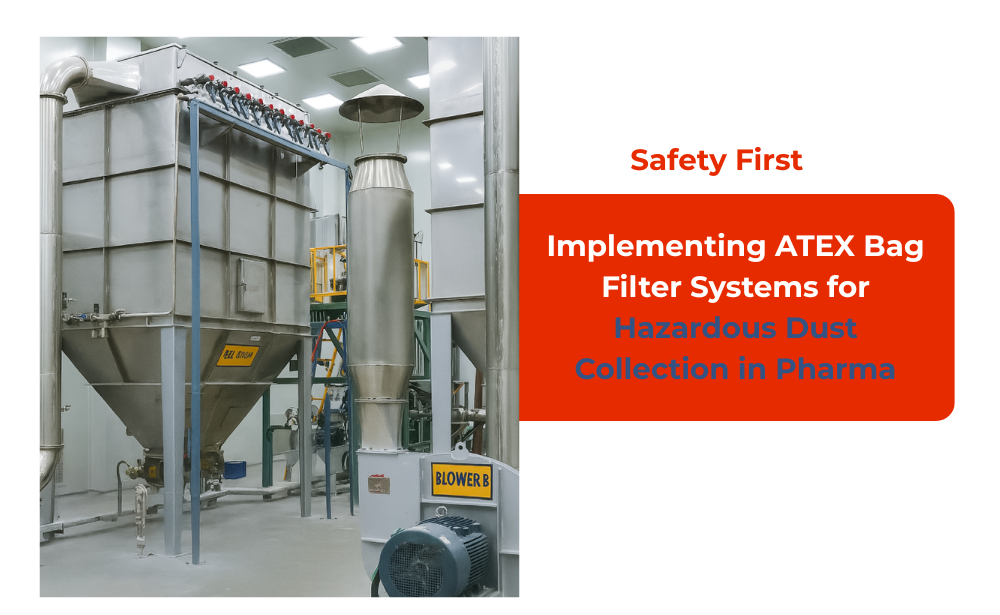
Powders such as APIs, excipients, and intermediates often combine fine particle size, combustible characteristics, and chemical reactivity, requiring dust collection systems that go beyond standard filtration.
In such environments, an ATEX bag filter becomes an essential part of the safety infrastructure.
Unlike conventional industrial dust collection systems, ATEX-certified equipment is engineered for hazardous area dust control, ensuring that filtration, containment, and explosion protection work as a unified, compliant solution, especially in facilities operating under stringent GMP practices.
This blog outlines why ATEX bag filters are the preferred choice for pharmaceutical dust collection and how TNBi integrates performance, safety, and regulatory expectations into every design.
Understanding the Pharmaceutical Dust Profiles
Pharmaceutical powders behave differently from typical industrial dusts. Key characteristics include:
Combustible properties
Many powders fall within explosive dust concentration ranges and have low minimum ignition energy (MIE), making an explosion-proof dust collector mandatory in classified zones.
Fine particle size
Sub-micron particles become airborne easily and require filtration media capable of very high efficiency.
Chemical reactivity
Some compounds are corrosive or hygroscopic, influencing material compatibility and long-term equipment performance.
GMP Requirements
Product recovery, containment, and GMP-friendly design remain essential for batch integrity and regulatory compliance.
What Makes an ATEX Bag Filter the Right Choice for Pharma?
ATEX compliance in India ensures that a dust collector can operate safely in explosive atmospheres. For pharmaceutical environments, this certification defines the minimum acceptable standard for safe filtration.
An ATEX-compliant bag filter incorporates multiple layers of protection:
Explosion Venting and Isolation
ATEX bag filters use pressure relief panels, explosion isolation valves, and flameless vents to safely contain and dissipate explosion energy, while ATEX-certified centrifugal fans and instruments eliminate ignition sources and ensure compliant system-wide protection.
Antistatic Design
Every component, from filter bags to structural elements, is designed to prevent static charge accumulation. Grounding systems and conductive materials ensure that the inevitable friction of air movement doesn’t become an ignition source.
Spark Detection and Suppression
Advanced systems integrate upstream spark detection that triggers suppression mechanisms before combustible material reaches the filter housing.
Zone-Appropriate Construction
Equipment is classified for Zone 20, 21, or 22 environments (for dust), matching the hazard level of the specific pharmaceutical process.
But compliance alone doesn’t make a system effective. The real engineering challenge is integrating explosion protection with the filtration performance that pharmaceutical operations demand.
Performance Where It Counts: TNBi's ATEX Bag Filter Design
Inside a pharmaceutical facility running TNBi’s ATEX bag filter, the air remains consistently clean, filtration stays steady across shifts, and batch environments maintain the purity needed for high-quality production.
Here’s what sets a properly engineered ATEX bag filter apart:
99.9% Filtration Efficiency
TNBi’s systems utilize pulse-jet cleaning with multi-layered filter bags that capture particles down to 0.3 microns while maintaining high airflow.
High Temperature and Pressure Capability
Spray drying, fluid bed processing, and milling operations can generate streams up to 260°C. TNBi’s ATEX bag filters handle these conditions while maintaining structural integrity up to 33 bar pressure, whether operating under vacuum or positive pressure.
Material of Construction (MOC) Flexibility
Available in SS304, SS316L, Duplex, Hastelloy, and other materials selected based on dust chemistry and corrosion potential.
Compact & Modular Design
Vertical or horizontal configurations maximize filter area within tight spaces and allow scalable capacity for high-volume operations.
Automated Pulse-Jet Cleaning
Automated cleaning stabilizes differential pressure, reduces manual intervention, and extends filter life in hazardous or classified zones.
When ATEX Bag Filters Are the Right Choice
Not every pharmaceutical dust collection application requires ATEX compliance. But when the conditions are right, there’s no substitute.
Choose an ATEX Bag Filter When:
- Handling combustible pharmaceutical powders (APIs, lactose, excipients)
- Operating in classified hazardous zones (Zone 20/21/22)
- Dealing with fine particulates requiring >99% capture efficiency
- Facing space constraints that demand compact, high-performance systems
- Needing corrosion-resistant MOCs for aggressive chemical environments
- Operating under vacuum or elevated pressure conditions
- Requiring automated, low-maintenance operation in hazardous areas
For non-combustible dust or lower-risk applications, standard bag filter systems may be sufficient. The correct choice depends on the actual hazard level and process behavior.
Conclusion: ATEX Bag Filters in Pharma Manufacturing
ATEX bag filters bring together explosion protection, high-efficiency filtration, and pharmaceutical-grade engineering in a single system. Their value comes from aligning safety requirements with GMP expectations and reliable plant performance.
With careful evaluation of dust properties, operating conditions, and installation constraints, these systems provide a dependable solution for handling hazardous pharmaceutical powders.
TNBi’s engineering team can assist in assessing dust characteristics and hazard classifications to recommend an ATEX bag filter tailored to the process.