
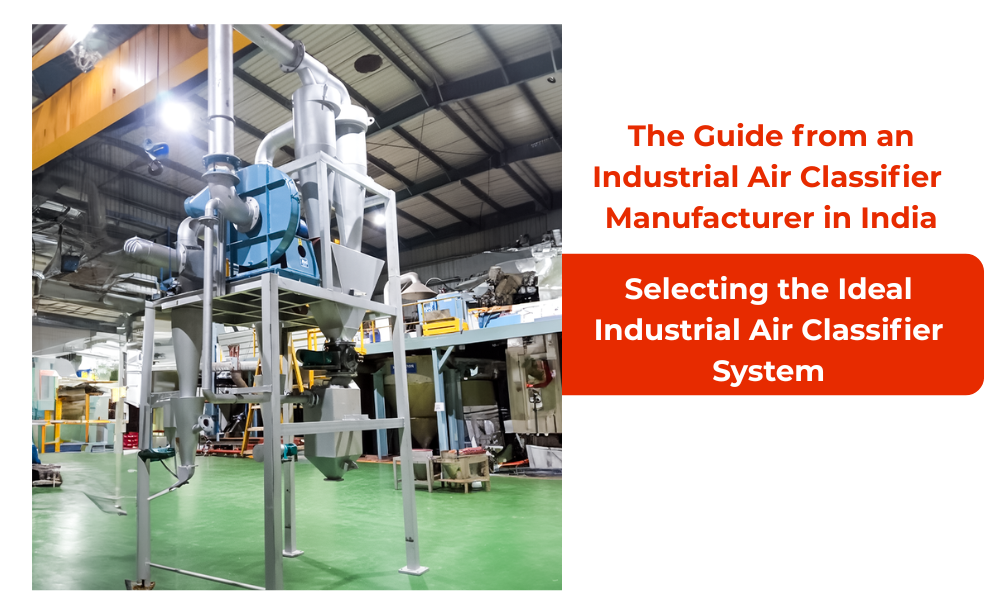
The Guide from an Industrial Air Classifier Manufacturer in India: Selecting the Ideal Industrial Air Classifier System
What to Consider Before Selecting the Industrial Classifier
Target Particle Size: The fine particle classification range you need depends on your product. TNBi’s classifier handles separation from 5 to 300 microns, covering a range that includes ultra-fine fly ash to coarser cement and mineral powders.
Production Capacity: classification systems must match your throughput requirements. Systems are available from 100 kg/hr for small-scale operations to 300 tons/hr for large-scale industrial production.
Material Type: Different powders behave differently. Paint pigments are sticky and light. Fly ash is ultra-fine. Plastic pellets are free-flowing. Your classifier should suit your specific material characteristics.
Why Moving Parts Create Problems
Many manufacturers face these recurring issues with traditional classifiers:
“Our classifier blades wear out too fast” – Abrasive materials like fly ash, granite, and metal powders destroy rotating components quickly, leading to expensive replacements and inconsistent separation.
“Separation drops in humid or rainy weather” – Monsoon conditions affect performance in traditional systems, causing production quality issues during critical months.
“Too much downtime due to filter choking” – Poor classifier design overloads bag filters, creating maintenance cycles that disrupt production schedules.
The No Moving Parts Solution
A no-moving-parts classifier solves these problems by using centrifugal separation instead of mechanical rotation. TNBi’s patented design delivers:
Zero wear – No replacement parts needed, no blade degradation
Consistent performance – Secondary air fine-tuning maintains cut size even during monsoons
Less downtime – Low-choke design prevents bag filter overload
Low maintenance – Minimum maintenance requirements reduce operational costs
Integration and Flexibility
Your air classifier manufacturer in India should offer integration options that fit your existing setup:
- Can be connected to a cyclone or bag filter
- Multiple-stage separation is possible in a single stream
- Different MOC (Material of Construction) options are available to suit your application
- Works downstream of mills for particle tuning
Applications Across Industries
TNBi’s classifier is used across seven major sectors:
- Power & Energy
- Paints & Pigments
- Food & Pharma
- Cement & Minerals
- Chemicals & Fertilizers
- Plastics & Polymers
- Metals & Mining
What Makes TNBi's Approach Different
Our patented classifier design offers:
- Accurate particle separation with secondary air fine-tuning
- Handles 100 kg/hr to 300 tons/hr product load
- Low operating and installation costs
- Separation accuracy from 5 to 300 microns
The system uses aerodynamic force to classify particles, eliminating mechanical wear and maintaining stable throughput with low operating costs.
Making Your Selection
When evaluating an industrial air classifier system, look beyond initial price. Consider:
- Can the system maintain performance during the monsoon season?
- Does it integrate with your existing cyclone or bag filter?
- What MOC options are available for your specific material?
- Is secondary air fine-tuning available for consistency?
- What are the actual maintenance requirements?
The right classifier delivers consistent separation, handles your capacity requirements, and maintains performance regardless of weather or material challenges.
Ready to discuss your particle separation requirements? Connect with TNBi’s technical team to evaluate how our patented classifier technology can improve your powder processing operations.