
Wet Scrubber Systems Explained: Types, Working Principle & Industrial Applications
In today’s competitive process industries, from pharmaceuticals to specialty chemicals, standard equipment no longer delivers the performance, flexibility, and productivity that modern plants demand.
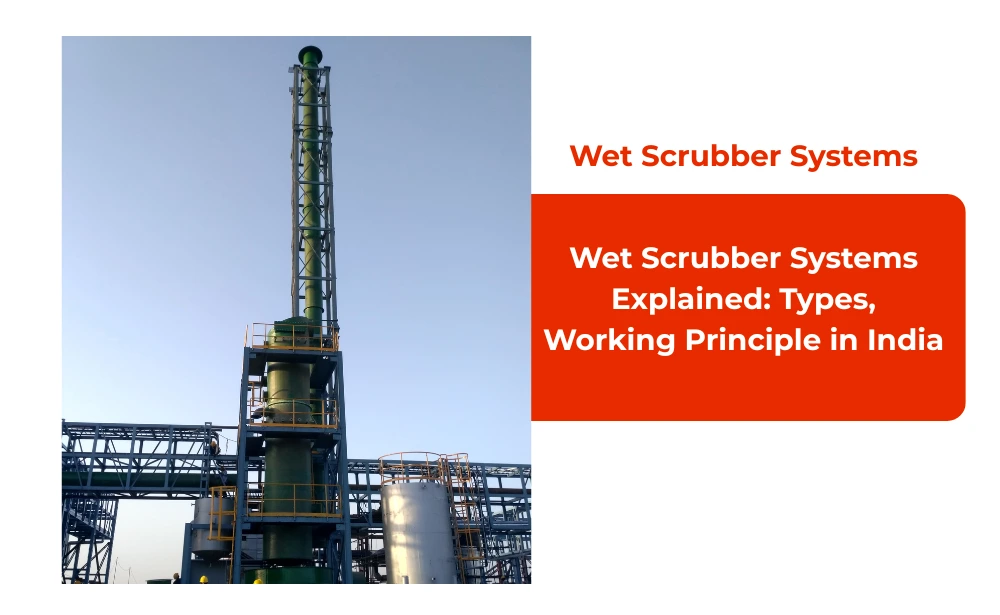
Wet scrubber systems are a fixture in chemical processing, pharmaceutical, metal smelting industries, solar, and fertilizer complexes, etc. They are critical for regulatory compliance, effectively removing gaseous pollutants, acidic fumes, and fine particulate matter from exhaust streams.
Selecting the appropriate wet scrubber requires a clear understanding of its function, operating principles, design options, and application suitability.
This guide explains wet scrubber working principles, types, design considerations, and industrial applications, providing the practical insights engineers require.
What Is a Wet Scrubber System?
A wet scrubber system is an industrial air pollution control device that removes contaminants, particulate matter, hazardous gases, acidic fumes, and VOCs from exhaust gas streams using a liquid medium, typically water or a chemical solution.
At its core, the mechanism is straightforward: the contaminated gas stream is brought into contact with a scrubbing liquid. Pollutants transfer from the gas phase into the liquid phase. The cleaned gas exits the system while the pollutant-laden liquid is collected for treatment or disposal.
Wet scrubbers are highly versatile because they can handle multiple pollutant types in a single unit. Depending on the design, they can address dust, corrosive gases, high-temperature streams, and combustible particulates simultaneously.
Wet scrubbers can be engineered to withstand inlet temperatures up to 1100°C and high pressures, and can be constructed from a range of materials, including FRP (fiberglass-reinforced plastic), PP (polypropylene), PVC (polyvinyl chloride), PVDF (polyvinylidene fluoride), PFA Lined, SS304 and SS316 (types of stainless steel), Hastelloy C-22 (a corrosion-resistant alloy), Refractory Lining and many more, depending on the application.
Wet Scrubber Working Principle
All wet scrubber systems operate on one key principle: gas-liquid contact for pollutant transfer. A wet scrubber is basically an air pollution control device that removes pollutants from a gas stream by absorption and impaction.
In this process, the contaminated gas is brought into contact with a scrubbing liquid (commonly water), where gaseous pollutants are absorbed into the liquid, and particulate matter is captured within droplets.
Finally, the cleaned gas is released, while the pollutant/laden liquid is collected for treatment or disposal.
The three core mechanisms at play are:
Impaction & Interception: Key mechanisms in wet scrubbers, where particulate matter entrained in the gas stream is captured by liquid droplets. In Venturi scrubbers, high gas velocities and fine droplet atomization enhance inertial impaction, making it the dominant removal mechanism for particles larger than about 1 µm, while interception and diffusion contribute to the capture of smaller particles.
Absorption: Gaseous pollutants (harmful gases in the exhaust) dissolve into the scrubbing liquid (the fluid used to clean the gas) through mass transfer across a gas-liquid interface (the surface where gas and liquid meet). Effective for various range of corrosive and hazardous gases like HCl (hydrogen chloride), HF (hydrogen fluoride), NH₃ (ammonia), HBr (hydrogen bromide), (NOx) (nitrogen oxides), VAM and HCN (hydrogen cyanide), and SOx (Sulfur Oxide)
Chemical Reaction: In many applications, a reactive scrubbing liquid (a liquid that reacts with pollutants), such as caustic soda (a strong base), lime solution (a suspension of calcium compounds in water), or an acid, chemically neutralizes the pollutant or converts them into less harmful compounds and, in some cases, useful byproducts, rather than just adsorbing (holding molecules on the surface) it. This is the mechanism behind the effective removal of SO₂ (sulfur dioxide), H₂S (hydrogen sulfide), and HF (hydrogen fluoride).
Wet scrubber efficiency depends on parameters such as gas velocity, liquid-to-gas ratio, contact surface area, packing type, throat design & Configurations, and pressure drop. Properly setting these parameters for the specific pollutant profile distinguishes high-performance systems from average ones.
Experienced manufacturers prioritize process data, such as gas composition, flow rate, inlet temperature, and outlet requirements- before configuring any system. Wet scrubbers are engineered solutions, not off-the-shelf products.
Types of Wet Scrubber Systems
No single wet scrubber design suits every application. Each type offers strengths tailored to specific pollutant challenges.
1. Venturi Scrubber
Best For: Particulate removal, combustible or abrasive dusts, high-temperature gas streams, sticky or explosive materials
The venturi scrubber working principle is based on impaction, interception, and diffusion. Contaminated gas accelerates through a converging section into an adjustable throat, which causes a significant pressure drop and very high gas velocity. At this point, scrubbing liquid is injected and atomized into fine droplets. Turbulence promotes collisions between gas-borne particles, and droplets effectively capture particulate matter.
After the throat, gas velocity decreases in the diverging section, allowing droplet-particle mixtures to separate. A downstream cyclonic separator then removes residual droplets, resulting in a clean gas stream.
Key technical highlights:
- Handles inlet temperatures up to 1100°C with either maximized surface area and efficient mass transfer or enhanced gas–liquid contact
- Treats multiple pollutants (dust and some gases) in a single device
- Ideal for combustible, corrosive, and abrasive dust streams
- Compact design compared to dry collection alternatives
- Available in adjustable-throat configurations for variable gas flows
Typical industries: Pharmaceutical powder suites, cement kilns, metal smelting, chemical reactors, food processing.
2. Packed Bed Scrubber
Best For: Soluble gas absorption, chemical fume neutralization, VOC control, acidic or alkaline emissions
The packed bed scrubber design achieves pollutant removal through either maximized surface area and efficient mass transfer or enhanced gas–liquid contact. The tower is filled with structured or random packing media (Q-Pack, rings, saddles, or grids) that create a large wetted surface area for gas-liquid interaction.
In a standard counter-current setup, contaminated gas enters from the bottom and flows upward, while scrubbing liquid enters from the top and flows downward. This arrangement ensures the cleanest liquid contacts the cleanest gas, maximizing overall absorption efficiency.
The scrubbing liquid removes pollutants through absorption for soluble gases, such as ammonia and HF, and through chemical reaction for gases requiring neutralization, such as SO₂ and H₂S.
Key technical highlights:
- Treats multiple gaseous pollutants (e.g. HCl, H₂S, HF, NH₃, SOx, NOx, HBr, HCN ) in a single unit
- Available in both vertical and horizontal configurations for space-constrained plants
- Lower operating cost and power consumption compared to high-velocity systems
- Multi-bed configurations for acidic and alkaline gases in one tower
- Designed to minimize clogging with easy access to internals
Typical industries: Chemicals, pharmaceuticals, semiconductors, EV battery manufacturing, fertilizer plants.
3. Multi-Stage Scrubber System
Best For: Complex exhaust streams with both particulate and gaseous pollutants; high-temperature streams combined with chemical fumes
When an exhaust stream contains multiple challenges, such as hot, dusty gas combined with gaseous pollutants, then multi-stage scrubber systems are used, with each stage targeting a specific pollutant type in sequence.
Common configurations include:
- Quench + Venturi: To reduce extreme inlet temperatures followed by efficient particulate removal
- Venturi + Packed Bed Tower: Dust removal followed by gas absorption
- Quench + Venturi + Multi-Stage Packed Tower: For the most complex process streams.
- Cyclone + Venturi + Packed Bed: All in one integrated unit
Typical industries: Metal smelting, cement, steel, power generation, pyrolysis, waste incineration, boiler, and furnace applications.
4. Horizontal Scrubber
Best For: Plants with limited vertical clearance, retrofit installations, acid gas removal in height-constrained facilities
A horizontal packed bed scrubber provides gas absorption performance comparable to a vertical packed bed tower, but with a compact footprint. In this configuration, gas flows laterally through the packed media rather than vertically, eliminating the need for tall tower structures.
This design is particularly suitable for retrofit applications and facilities with restricted installation height, while still maintaining effective gas–liquid contact and high absorption efficiency for acid gases.
Typical industries: Semiconductors, pharmaceuticals, specialty chemicals, and any facility where installation height is a constraint.
Wet Scrubber Types at a Glance
Scrubber Type | Primary Use | Key Strength | Typical Industries |
Venturi Scrubber | Particulate & dust removal | Handles High-temp, combustible & abrasive dust, adjustable for gas flow, commonly used for dust control. | Chemical, Pharma, Cement, Metals, Food, and many more. |
Packed Bed Scrubber | Gas absorption & neutralisation | Soluble gases — HCl, HF, NH₃, SOx, NOx, HBr, HCN, CO2, VOCs and many more | Chemicals, Pharma, EV Batteries, Solar, Fertilisers, and Many more. |
Multi-Stage Scrubber | Combined dust + gas treatment | Handles complex mixed pollutant streams | Smelting, Steel, Power, Pyrolysis, and many more. |
Horizontal Scrubber | Acid gas removal, space-limited plants | Low height requirement — retrofit-friendly | Semiconductors, Pharma, Retrofit Projects, and many more. |
Industrial Applications of Wet Scrubber Systems
Chemical & Petrochemical Industry
Chemical plants generate some of the most aggressive exhaust streams, such as acidic gases (HCl, HF, H₂SO₄ mists, etc.), toxic fumes (HCN, BF₃, DCPD, etc.), and reactive vapors. An air pollution control scrubber for chemical applications must handle wide variations in gas composition, withstand highly corrosive media, and maintain consistent performance across batch operations.
Packed bed scrubbers in multi-stage configurations are standard. For streams containing both particulate and gaseous pollutants, Venturi plus packed-bed systems provide effective dual treatment.
Pharmaceutical Manufacturing
Pharmaceutical facilities emit VOC-laden exhaust from tablet coating and solvent synthesis, API dust from powder handling, and acidic fumes from chemical reactions. VOC scrubber systems for these applications must comply with regulatory standards, manage fluctuating batch concentrations, and integrate with existing fume extraction systems.
The general configuration includes absorption-based packed bed scrubbers followed by an activated carbon bed. Where necessary, a Venturi pre-stage protects the packed bed from particulate fouling.
Metal Processing & Smelting
Smelting produces high-temperature flue gas containing fine particulate matter, heavy metals, SOx, and HF, etc. Capture-point temperatures often exceed 800–1100°C, making dry filtration impractical. Multi-stage industrial wet scrubbers, with quench, Venturi, and packed-bed towers, handle temperature, remove dust, and neutralize chemicals in a single system.
Power Generation & FGD
Combustion processes emit SOx, NOx, CO₂, particulate matter, mercury, and heavy metals. Packed bed scrubbers with lime or caustic media are essential for FGD operations. Multi-stage systems address both particulate and gaseous pollutants in facilities using biomass or solid fuels.
EV Battery & Semiconductor Manufacturing
EV battery manufacturing produces HF and NMP fumes, which are hazardous and highly soluble, requiring precise chemical fume scrubber treatment. Semiconductor fabrication generates HCl, HF, HNO₃, ammonia, and VOCs. Both sectors require scrubbers made from corrosion-resistant materials such as PVDF, PTFE, and Hastelloy, with multi-stage treatment capability. Horizontal scrubbers are often preferred due to cleanroom height constraints.
How to Select the Right Wet Scrubber System
There is no “one-size-fits-all” solution. The optimal system depends on the specific process’s pollutant profile and operating conditions.
Experienced air pollution control engineers consider the following critical criteria before specifying a system:
- According to the pollutant profile: If it is particulate matter, then Venturi; if soluble gases, then Packed Bed; and if both together, then choose a multi-stage system.
- As per the inlet temperature: Streams above 200°C typically require pre-cooling via. quench section before any packed-bed stage.
- Combustible or sticky dusts: Wet scrubbers are often the preferred choice for dusts that pose explosion risks in dry filtration, or for particles that would blind or clog a filter bag.
- Space constraints: Plants with limited height benefit from horizontal scrubber designs, while compact vertical Venturi systems are suitable for tight process floor layouts.
- Outlet emission norms: CPCB norms and International Air Quality Guidelines define permissible outlet concentrations. System design must reliably meet these through continuous operation, not just at commissioning.
- Required Material of Construction: The material of construction (MOC) must be chemically compatible with both the gas and the scrubbing liquid, from FRP, PP, and PVC to SS304L, SS316L, SS904L, and Hastelloy C-22 etc.
When in doubt, provide process data, gas composition, flow rate, inlet temperature, and outlet norms to a qualified wet scrubber manufacturer. Systems designed from actual data consistently outperform those selected from product sheets.
Conclusion
Wet scrubber systems have been central to industrial air pollution control for decades, and for good reason. Their ability to handle high temperatures, treat multiple pollutant types in a single unit, and safely manage combustible or corrosive dust streams makes them unmatched for a wide range of applications.
However, performance depends on design quality and correct application matching. A Venturi scrubber specified for gas absorption will underperform, while a packed bed scrubber used for a dusty, high-temperature stream will foul quickly. Engineering decisions at the specification stage are critical to long-term success.
At TNBi Industries, every scrubber system is engineered based on process data. With patent-backed designs, over a decade of proven field performance, and experience across chemical, pharmaceutical, metal processing, power generation, and EV battery industries, we deliver systems that meet emission norms from day one and maintain performance throughout their operational life.
We will design an optimized, cleaner solution tailored to your specific operational needs.
FAQs
How does a wet scrubber system work?
A wet scrubber system works by passing contaminated gas through a scrubbing liquid. Pollutants, dust, acidic gases, or VOCs, transfer from the gas phase into the liquid through impaction, absorption, or chemical reaction. The cleaned gas exits the system; the pollutant-laden liquid is collected for treatment.
What are the main types of industrial wet scrubbers?
The main types of industrial wet scrubbers are Venturi scrubbers (for particulate and dust removal), Packed bed scrubbers (for gas absorption and chemical fumes), Multi-stage scrubbers (for combined pollutant streams), and Horizontal scrubbers (for height-constrained or retrofit installations). Selection depends on pollutant type, temperature, and process conditions.
What is the difference between a Venturi scrubber and a Packed bed scrubber? secondary
A Venturi scrubber uses high-velocity gas-liquid collision to capture particulate matter — best for dusty, high-temperature, or combustible streams. A Packed-bed scrubber relies on surface contact and absorption to remove soluble gases such as HCl, HF, and NH₃. When a stream contains both, a combined Venturi + packed bed system is used.
Which industries use wet scrubber systems for air pollution control?
Wet scrubber systems are widely used across Chemical processing, Pharmaceuticals, Metal smelting, Cement, Power generation, Fertilizers, EV battery manufacturing, Rubber, Paint, and Semiconductor manufacturing. Any facility producing acidic fumes, toxic gases, fine dust, or VOCs that needs to meet CPCB emission norms benefits from an industrial air scrubber system.
Can a wet scrubber remove VOCs and chemical fumes?
Yes. A VOC scrubber system based on packed bed absorption effectively removes water-soluble solvents, acidic gases, and reactive fumes from exhaust streams. For complex pharmaceutical or chemical applications, multi-bed configurations with custom scrubbing media, or an activated carbon polishing stage, are used to meet stringent outlet emission norms.