
Venturi Scrubber Working Principle: How It Removes Fine Particulates and Hazardous Fumes
Published by TNBi Industries | Air Pollution Control Experts, Pune
Across Metal Refining and Manufacturing, Fertilisers and Petrochemicals, Cement Kilns, Steel, Furnaces, Pharmaceutical Powder Suites, Chemical Reactors, and Waste Incinerators, Venturi Scrubbers consistently sit at the point where contaminated gas meets the atmosphere.
A venturi scrubber efficiently removes abrasive, corrosive, and combustible dust particulates, with a much more compact design compared to dry collection, and is the safest way to control combustible and explosive dust.
Understanding the Venturi Scrubber working principle is essential for engineers, managers, and technical or non-technical persons working in the aforementioned industry. With this knowledge, they can confidently specify, operate, and evaluate these systems.
In this article, we walk you through the working principle, from the fundamental mechanisms to design configurations, efficiency factors, and real-world industrial applications.
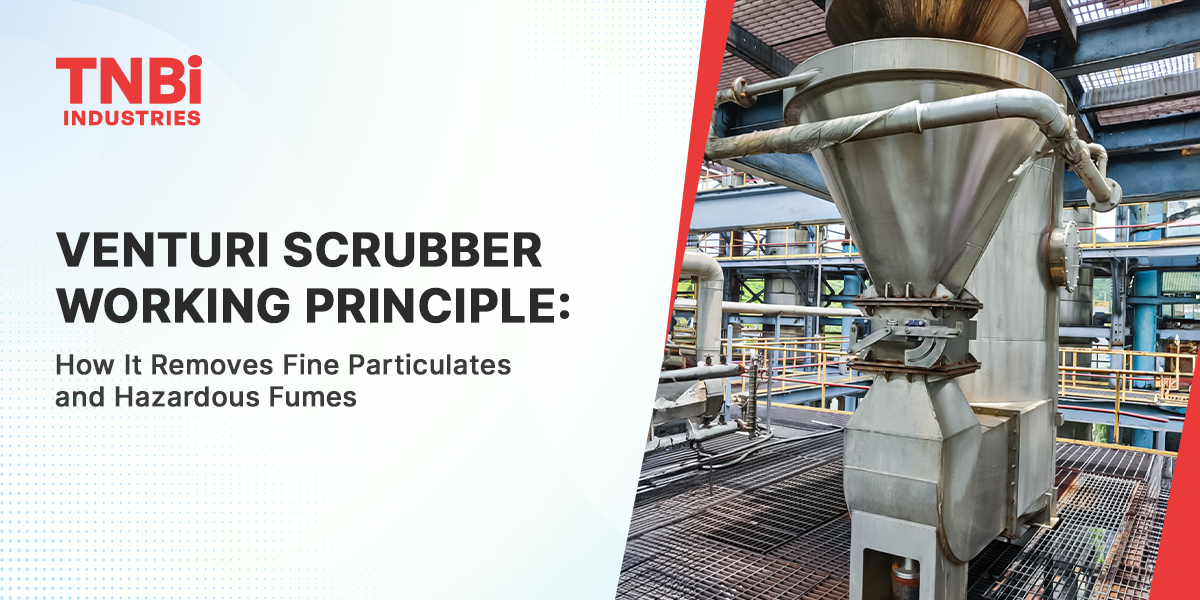
What Is a Venturi Scrubber?
A venturi scrubber is a wet scrubber for particulate removal. It uses impaction, Interception, and diffusion principles, where high gas velocities and fine droplet atomization enhance inertial impaction, making it the dominant removal mechanism for particles larger than about 1 µm, while interception and diffusion contribute to the capture of smaller particles.
The venturi scrubber’s distinctive converging-diverging section accelerates gas at the throat to meet the scrubbing liquid at high velocity, then slows it in the expanding section, allowing droplets and particles to separate downstream.
TNBi’s venturi scrubber features a patented involute breaker design that maximizes particle capture while minimizing pressure drop. It handles inlet temperatures up to 1100°C and pressures up to 20 bar, and removes particulates with above 99.9% efficiency at 1 micron. ATEX-compliant options are available for combustible and explosive dust environments.
Venturi Scrubber Working Principle
A Venturi Scrubber works on three governing principles: impaction, interception, and diffusion. These principles act on particles of different sizes as contaminated gas is accelerated, brought into high-velocity contact with scrubbing liquid, and then separated downstream.
Stage 1 — Acceleration Through the Converging Section
Contaminated gas enters the venturi’s converging section. As the area narrows toward the throat, gas speeds up to 60-120 m/s, and static pressure drops per the Bernoulli principle.
This acceleration creates a high-energy environment, enabling the next step in particle capture. When the throat velocity increases, turbulence rises, and gas-borne particles come into more effective contact with scrubbing liquid droplets.
Stage 2 — Liquid Injection and Particle Capture Through Impaction, Interception, and Diffusion
Operators inject the scrubbing liquid, usually water or a chemically adjusted solution, at or just before the throat. The high-velocity gas stream instantly breaks the liquid into fine droplets, creating countless targets for suspended particles.
This is where the venturi scrubber’s three working principles operate simultaneously:
- Inertial impaction: Particles with enough mass can’t follow curved gas streamlines and collide directly with droplets, the main mechanism for particles above 1 µm. High throat velocities (60 to 120 m/s) ensure effective impaction across particle sizes.
- Interception: As particles follow gas streamlines, they may pass close enough to a droplet for contact. This matters for mid-range particles (0.1 to 1 µm) that are not heavy enough for significant inertia but are large enough to make contact.
- Diffusion: Sub-micron particles (below 0.1 µm) move erratically due to Brownian motion, causing them to collide with droplets. Smaller particles are captured more efficiently via diffusion, the main process for the tiniest aerosols.
When both particulates and soluble gases (such as HCl, HF, SO₂, or NH₃) are present, the scrubbing liquid is chemically adjusted to absorb gases while capturing particles. This enables both particulate and partial gas absorption in one compact unit.
Stage 3 — Deceleration and Droplet-Particle Separation
Once past the throat, the gas-liquid mixture flows into the diverging section. The velocity drops, the static pressure recovers, and heavier droplets carrying the particles move toward the walls. The system collects this particle-laden liquid and drains it to the sump.
The gas stream then travels to a separator, usually a cyclonic separator or a demister. In this separator, the system removes any remaining liquid droplets. Only then is the cleaned gas released to the atmosphere or sent to a downstream packed-bed stage for further gas-phase treatment.
Venturi Scrubber Efficiency: What Governs Performance
The venturi scrubber’s particulate removal efficiency is governed by a set of interrelated design and operating parameters. These parameters are not independent variables. Changing one affects the others. The optimum configuration is determined by specific process data, such as dust type, particle size distribution, inlet loading, gas temperature, and required outlet emission norm.
Parameter | Our Design | Advantages |
Gas Entry | Horizontal | Lower ducting modifications, Less pressure drop in ducting, Easy to adjust ID fan VFD with constant operating conditions. |
Separator Section | Cyclonic Entry | Better particle removal efficiency, with dual-stage scrubbing (Venturi + vortex in cyclonic separator) |
Foam backflow to upstream | Different Inlet | Less chance of foam to spread to upstream equipments |
Particle Collection Efficiency | Constant efficiency | More reliability |
Size of Scrubber | Compact | Lower footprint |
In practice, engineers optimize the design of venturi scrubbers for high-temperature or high-dust-load applications.
Examples include cement kilns, steel furnaces, and incinerators. These scrubbers operate at higher throat velocities and pressure drops, typically 15-22 mbar, to achieve the required collection efficiency. For pharmaceutical or chemical vent applications with lower loads, designers may choose lower pressure drops and gentler operating conditions.
TNBi’s patented involute design optimizes the geometry of the throat and diverging section to achieve maximum particle capture at minimum pressure drop. This approach directly reduces operating energy costs while maintaining compliance with CPCB outlet emission norms.
Industrial Applications of Venturi Scrubbers
The venturi scrubber is the preferred wet scrubber for particulate removal across a range of industries where dry filtration is constrained by temperature, combustibility, stickiness, or the simultaneous presence of gaseous pollutants. The following applications represent the primary industrial contexts where venturi scrubbers are specified.
Metal and Mineral Processing
Metal refining and mineral processing operations, including ore roasting, sintering, and clinker production, generate fine, high-temperature particulate in high-volume gas streams. Inlet temperatures often exceed 300–600°C at the capture point, which makes bag filters impractical without extensive pre-cooling. A Venturi Scrubber handles the gas directly at temperature, captures metallic and mineral fines through impaction, and eliminates the need for a dedicated cooling tower upstream.
Steel, Foundry, and Non-Ferrous Metallurgy
Arc and induction furnaces, converters, and smelters produce high-temperature off-gases laden with fine metallic particulate, metal oxide fumes, and, often, co-present acidic gases. Dry bag filters are not appropriate for combustible metallic dusts or high-temperature streams.
A venturi scrubber, specified in Hastelloy C-22 or SS316L for corrosive gas profiles, captures the particulate and provides partial gas absorption in a compact footprint.
Chemical Processing and Acid Plants
Chemical reactors and acid-handling operations generate exhaust streams that contain fine particulate aerosols alongside acidic gases. A venturi scrubber can be used as a pre-stage to a downstream packed bed scrubber.
In this role, it removes the particulate burden first and protects the packed bed from fouling. It also provides initial gas absorption. This staged configuration is a standard arrangement in chemical plant venturi scrubber design.
Pharmaceutical Manufacturing
Tablet coating, granulation drying, and API handling operations produce fine powder-laden exhaust. When the dust is combustible, as is the case with many pharmaceutical powders, a venturi scrubber provides inherently safer collection than a bag filter by eliminating the risk of filter-media ignition.
TNBi’s pharma case study documented the replacement of a legacy system that suffered from a 750 mm Wg pressure drop and foam backflow. The new venturi-based unit reduced the pressure drop to 300 mm Wg. It also eliminated corrosion-related failures entirely.
Waste Incineration and Pyrolysis
Incinerators and pyrolysis units produce flue gas with high fly ash loadings, heavy metals, HCl from chlorinated waste, and SO₂. The venturi scrubber is well-suited as the first treatment stage: it handles the high-temperature inlet, captures the coarse and fine fly ash fractions, and begins HCl and SO₂ absorption. A packed-bed tower downstream completes the gas treatment.
Refineries and Catalytic Crackers
Fluid catalytic cracking (FCC) units in refineries generate fine catalyst fines in hot regenerator flue gas. A venturi scrubber captures particulates while handling the high inlet temperature, protecting downstream equipment and helping meet stack emission norms for PM and SO₂.
Material of Construction — Matching MOC to Process Chemistry
Solvent removal with carbon bed filters is a common industrial use of activated carbon.
These systems
The venturi scrubber design must account for the chemical aggressiveness of the gas stream and scrubbing liquid, not just the temperature and flow rate. TNBi offers the following MOC options based on process chemistry:
- SS316L
- Hastelloy C-22
- FRP (Fiber-Reinforced Plastic)
- PP (Polypropylene)
- MS/CS with internal lining
are used where exhaust streams contain:
- IPA vapors
- Ethanol
- Methanol
- Ketones
- Aromatic solvents
- Coating solvents
As the solvent-laden air passes through the carbon bed, VOC molecules become adsorbed onto the carbon surface.
In pharmaceutical and chemical manufacturing, activated carbon beds are frequently installed as polishing stages following wet scrubbers to capture residual solvent vapors remaining after initial gas treatment.
When a Venturi Scrubber Is the Right Choice — and When to Combine
A venturi scrubber is the appropriate primary technology when the process involves one or more of the following situations:
– Inlet gas temperatures above 200°C. At these levels, bag filter pre-cooling would add significant capital and operating costs.
– Combustible, explosive, or pyrophoric dust. Here, the absence of filter media eliminates the risk of ignition.
– Abrasive dust that would cause rapid bag wear in a fabric filter system.
– High inlet dust loading greater than >20 g/Nm³) that exceeds practical bag filter loading limits.
– Sticky or hygroscopic particulate that would blind fabric filter bags.
– Combined particulate and soluble gas treatment is required in a single compact unit.
When the process also involves high concentrations of soluble gases, such as HCl, HF, NH₃, SO₂, or H₂S, engineers typically combine a Venturi Scrubber with a downstream packed bed tower. This combination provides comprehensive treatment.
The venturi handles the particulate and high-temperature conditioning. The packed bed absorbs the gaseous pollutants. This Venturi plus Packed Bed configuration is the standard multi-stage arrangement for chemical, metallurgical, and incineration applications.
TNBi Industries: Venturi Scrubber Design and Manufacturing
TNBi Industries has designed and manufactured venturi scrubbers in Pune since 2012, serving fertilizers, metals refining, cement, steel, chemicals, pharmaceuticals, non-ferrous metallurgy, power, waste management, and petrochemical industries across India and worldwide.
TNBi’s venturi scrubber range uses a patented involute design that achieves over 99.9% particulate removal at 1 micron, handles inlet temperatures up to 1100°C, and operates at pressures up to 20 bar. Systems are available in SS316L, Hastelloy C-22, FRP, PP, and Duplex, depending on process chemistry, with ATEX-compliant configurations for combustible dust environments.
Technical specifications:
- Gas flow capacity: Up to 500,000 Nm³/hr
- Particulate removal efficiency: >99.9% at 1 micron
- Inlet temperature: Up to 1100°C
- Operating pressure: Up to 20 bar
- Pressure drop: 12–22 mbar depending on operating conditions
- MOC: SS316L, MS, Duplex, Hastelloy C-22, FRP, PP,
- Gas types: Acidic, alkaline, and neutral; ATEX-compliant design available for combustible dust
Engineers configure every venturi scrubber design using process data such as gas composition, flow rate, inlet temperature, dust loading, and outlet emission norm. Standard configurations are available for rapid deployment. Engineers also create custom designs for complex or high-severity process conditions.
Conclusion
Activated carbon filters effectively control VOCs, solvent vapors, hydrocarbon emissions, and odors in industrial settings.
However, successful performance requires a thorough understanding of the activated carbon filter working principle, appropriate selection of carbon media, accurate filter sizing, and evaluation of whether activated carbon is used as a primary treatment stage or as a polishing system following other air pollution control equipment.
Tell us about your gas stream composition, flow rate, temperature, and outlet emission requirement. We’ll configure the right venturi scrubber design for your process.
sales@tnbiindustries.com | +91 92255 61222 | www.tnbiindustries.com
Frequently Asked Questions
What is the working principle of a Venturi Scrubber?
A venturi scrubber works on three principles: impaction, interception, and diffusion. Contaminated gas accelerates through a converging throat, where scrubbing liquid is atomized into fine droplets; impaction captures particles above 1 µm, interception captures mid-range particles, and diffusion captures sub-micron particles. The particle-laden liquid then separates in the downstream diverging section and the cyclonic separator.
What is the difference between a fixed throat and an adjustable throat venturi scrubber?
A fixed-throat venturi scrubber is designed for consistent gas flow rates and optimized at a single operating point. An adjustable throat venturi scrubber uses a movable plunger to vary the throat area, maintaining constant gas velocity and pressure drop across variable or fluctuating flow rates.
What factors affect venturi scrubber efficiency for fine particulate removal?
Venturi scrubber efficiency is governed by throat gas velocity, liquid-to-gas ratio, droplet size, and operating pressure drop. Higher throat velocity increases turbulence and impaction for finer particles. Pressure drop (typically 1–22 mbar) is the primary design variable that balances collection efficiency with energy consumption.
What industries use Venturi Scrubbers for particulate and fume control?
Venturi Scrubbers are widely used in cement kilns, steel furnaces, non-ferrous smelters, pharmaceutical powder handling, chemical processing, waste incineration, and refineries. They are the preferred wet scrubbers for particulate removal in high-temperature processes, combustible-dust environments, and applications requiring combined particulate and soluble gas treatment.
How is a venturi scrubber designed for high-temperature or corrosive gas applications?
Venturi scrubber design for high-temperature or corrosive applications involves selecting appropriate materials: SS316L for moderate exposure, Hastelloy C-22 for highly corrosive gases (pH 0.5–14), FRP for acidic streams at lower temperatures. The system can handle inlet gas temperatures up to 1100°C without upstream pre-cooling equipment.